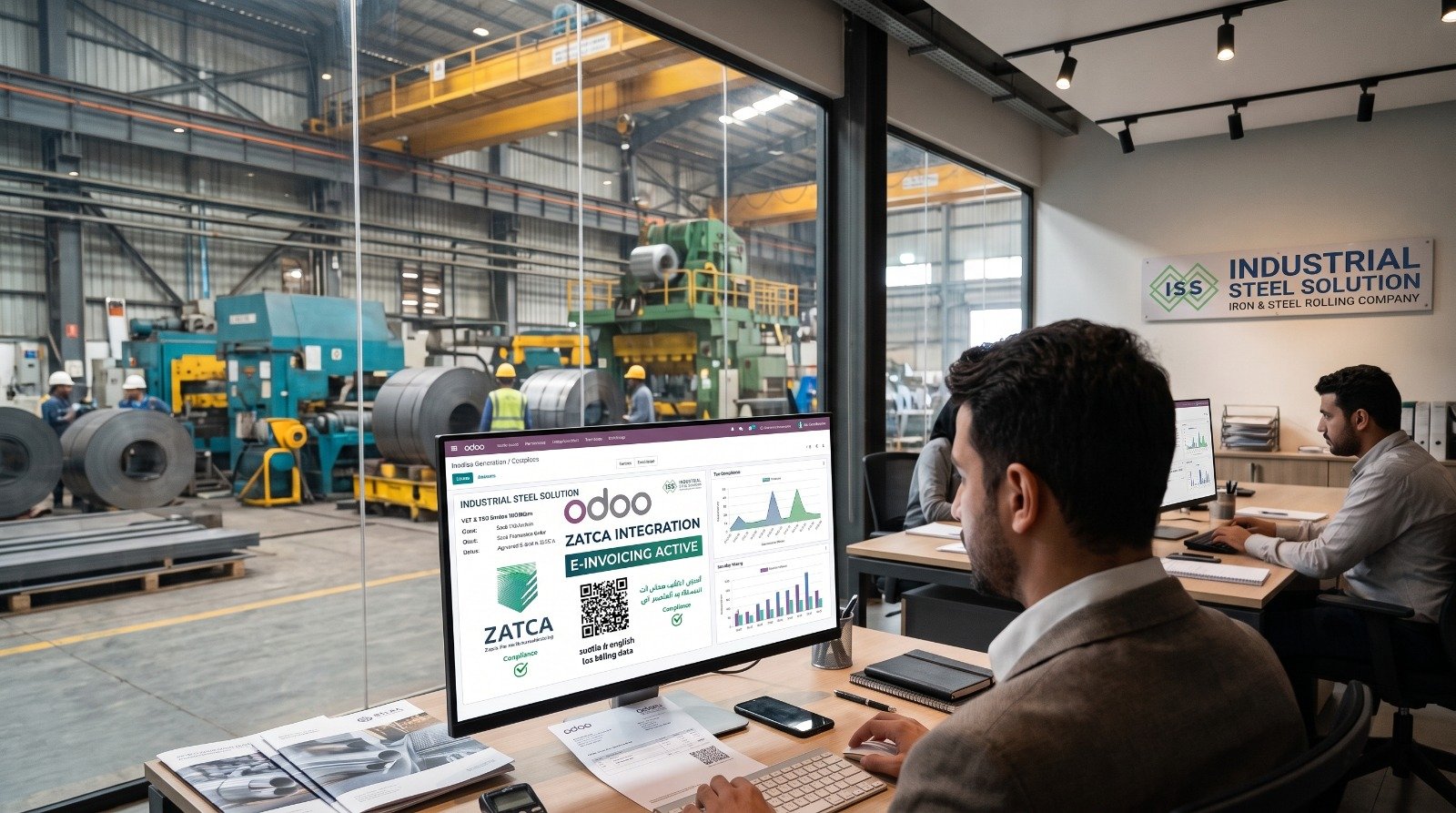
This Odoo ZATCA integration case study shows how Industrial Steel Solutions, a steel trading and distribution company in Saudi Arabia, moved from manual bookkeeping to automated, compliant e-invoicing. As the business grew, keeping up with accounting, VAT, and the Phase 2 rules from the Zakat, Tax and Customs Authority (ZATCA) became harder to manage with spreadsheets and manual entries.
To support that growth and stay compliant, the company partnered with OzonLayer, a verified Odoo Silver Partner based in Riyadh. Together, we implemented Odoo Accounting with full ZATCA e-invoicing, automated VAT processing, and bank reconciliation. Below, we cover the challenges, the setup, how we delivered it, and what changed for the finance team.
In this case study

Industrial Steel Solutions at a glance
| Item | Details |
|---|---|
| Client | Industrial Steel Solutions |
| Industry | Steel trading and distribution |
| Location | Saudi Arabia |
| Solution | Odoo Accounting with ZATCA e-invoicing integration |
| Implementation partner | OzonLayer IT Services |
| Modules | Odoo Accounting, ZATCA e-invoicing integration, VAT management |
| Services | Accounting process assessment, implementation, ZATCA Phase 2 integration, VAT configuration, user training, go-live support, ongoing compliance support |
| Headline results | 100% ZATCA-compliant invoicing process, automated invoice clearance and reporting, faster month-end closing |
About the client
Industrial Steel Solutions is a leading steel trading and distribution company operating in Saudi Arabia. Like most distributors in this sector, its finance team handles a steady flow of sales invoices, supplier bills, credit notes and customer statements, and every one of those documents has tax and cash flow consequences.
As operations expanded, the volume and complexity of that work grew with them. Accounting processes, VAT compliance and the new e-invoicing requirements all had to be handled at once, and the manual methods that worked for a smaller business were no longer enough. Management wanted one system, which became Odoo Accounting, to keep the books accurate, keep the company compliant with Saudi regulations and give them a clear view of the numbers.
The business challenges
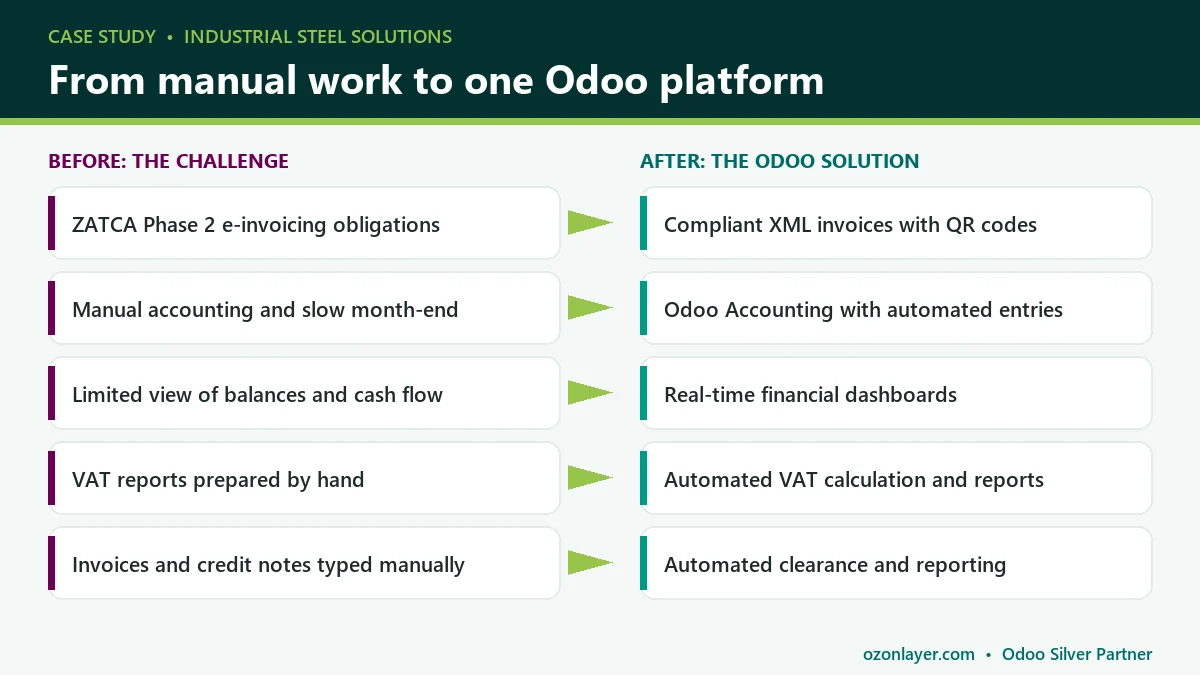
Before the project, the finance function faced five connected problems. Each one added risk or slowed the team down, and together they made growth harder to manage.
ZATCA compliance requirements
The company needed to comply with Saudi Arabia’s ZATCA Phase 2 e-invoicing regulations. That meant generating QR codes, producing invoices as structured XML files and sending invoices to ZATCA for clearance or reporting.
Phase 2, also called the integration phase, goes well beyond printing a compliant PDF. The invoicing system itself has to connect to ZATCA’s FATOORA platform, sign each invoice and exchange data in real time. A manual or spreadsheet-based process cannot do that, so the company needed an accounting system with ZATCA e-invoicing built in.
Manual accounting processes
Financial transactions were recorded manually. Every manual entry carries a chance of error, and errors in a trading business are expensive: a wrong amount on a customer invoice, a missed supplier bill, or a misposted payment can take hours to trace. Manual recording also delayed month-end closing, because the team had to check and correct entries before the books could be trusted.
Limited financial visibility
Management lacked real-time access to financial reports, customer balances, supplier liabilities and cash flow information. In steel distribution, where customers often buy on credit terms and margins depend on careful purchasing, late numbers make it hard to decide who to extend credit to, which suppliers to pay first and how much cash is really available.
VAT management challenges
Preparing VAT reports and making sure they matched Saudi tax regulations required significant manual effort. When VAT is calculated by hand or pulled together from separate files at the end of each period, the return takes longer to prepare and is harder to defend in a tax audit.
Invoice processing delays
Sales invoices, credit notes and customer statements were generated manually, which slowed down financial operations. Slow invoicing delays collections, and slow statements make it harder for customers to reconcile their own accounts and pay on time.
Why Industrial Steel Solutions chose Odoo and OzonLayer
The company needed more than an e-invoicing add-on. It needed a full accounting system that would handle the general ledger, receivables, payables, banking and VAT, with ZATCA compliance built into the same invoicing flow. Odoo Accounting fits that need well, because invoices, taxes, payments and reports all live in one database instead of separate tools that have to be kept in sync.
Odoo also has a Saudi Arabia fiscal localization that covers the local chart of accounts, VAT taxes and ZATCA e-invoicing. You can read how it works in the official Odoo documentation for Saudi Arabia. A localization alone is not a finished system, though. Someone has to map the company’s processes, configure taxes correctly, complete onboarding with ZATCA and train the users.
That is where OzonLayer came in. We are a verified Odoo Silver Partner based in Riyadh, and we implement, customize, integrate and support Odoo for businesses in Saudi Arabia and the UK. Our Odoo implementation services in Saudi Arabia are built around local requirements such as VAT and ZATCA, so compliance is part of the plan from the first workshop. If you are still comparing providers, our guide on how to choose an Odoo partner explains what to look for.
The solution: Odoo Accounting with ZATCA e-invoicing
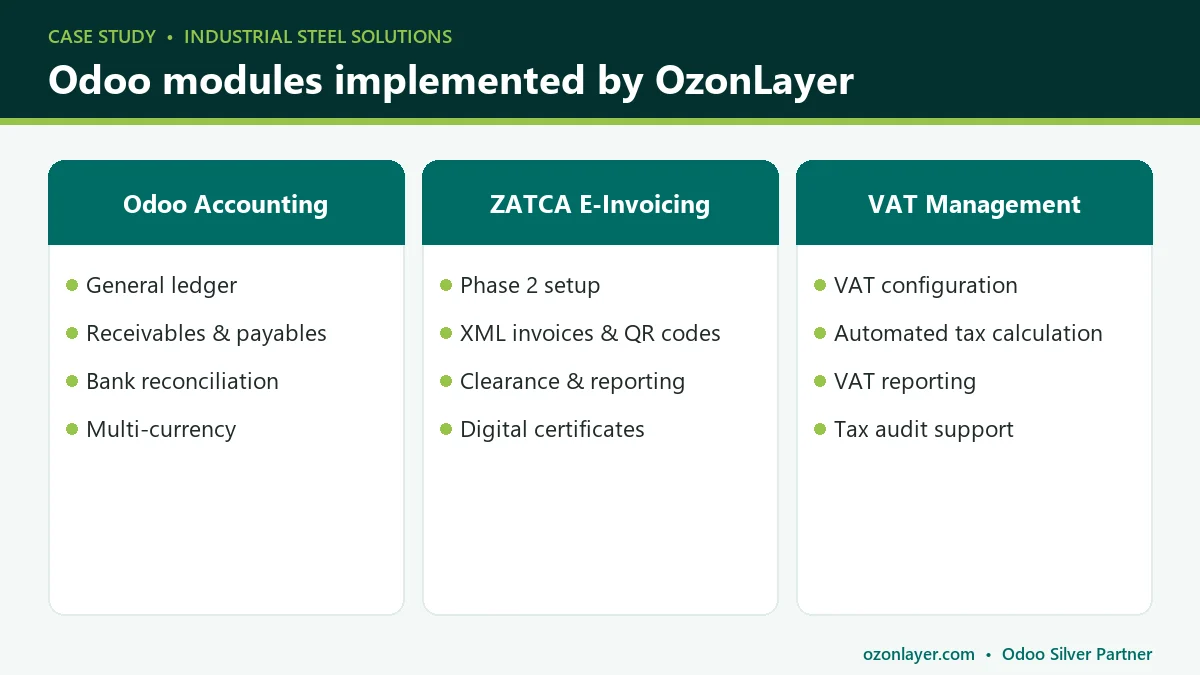
OzonLayer implemented Odoo Accounting with ZATCA e-invoicing integration to automate financial operations and ensure regulatory compliance. The solution was organized into three areas: core accounting, the e-invoicing integration and VAT management.
Odoo Accounting
Odoo Accounting became the financial backbone of the business. We set up the general ledger and journals so that every sales invoice, vendor bill and payment posts to the right accounts automatically. Receivables and payables are tracked per customer and supplier, with aging reports that show what is due and what is overdue.
Bank reconciliation was configured so imported bank statement lines can be matched to open invoices and bills, with reconciliation models handling recurring patterns. Odoo’s bank reconciliation documentation describes the matching tools in detail. Multi-currency support lets the team record transactions in foreign currencies and handle exchange differences, which matters for any trader that buys or sells across borders.
- General ledger
- Accounts receivable
- Accounts payable
- Bank reconciliation
- Financial reporting
- Multi-currency management
For a wider view of what the app can do for Saudi companies, see our page on Odoo accounting software for VAT and ZATCA.
ZATCA e-invoicing integration for Phase 2
The second area was the Odoo ZATCA integration itself. Under Phase 2, standard tax invoices issued to businesses follow a clearance model: the invoice is sent to ZATCA for validation and must be cleared before it is shared with the buyer. Simplified tax invoices, typically issued to consumers, follow a reporting model and must be reported to ZATCA within 24 hours of issue.
Each invoice is produced as a UBL 2.1 XML file, carries a cryptographic stamp and includes a QR code. To connect, the taxpayer onboards each invoicing unit through the FATOORA portal and obtains a Cryptographic Stamp Identifier (CSID) certificate. The ZATCA e-invoicing portal publishes the official rules and technical guidance.
OzonLayer completed the Phase 2 compliance setup, configured the digital certificates and connected Odoo so that XML generation, QR codes and clearance or reporting happen as part of normal invoice posting. Credit notes follow the same compliant flow, so corrections are handled correctly too.
- Phase 2 compliance setup
- XML invoice generation
- QR code generation
- Invoice clearance and reporting
- Credit note compliance
- Digital certificate configuration
VAT management
The third area was VAT. We configured the VAT taxes and fiscal positions so the correct rate is applied automatically on sales and purchases. Because every invoice and bill carries its tax lines, VAT reports are built from posted transactions rather than separate spreadsheets. Each figure on the return can be traced back to the source documents, which supports tax audits.
- VAT configuration
- Automated tax calculation
- VAT reporting
- Tax audit support
Key features implemented
Beyond the module setup, five features made the biggest difference to how the finance team works each day.
Automated e-invoicing
All customer invoices are now generated automatically in ZATCA-compliant format, with the required QR codes and XML files. With ZATCA e-invoicing running inside Odoo Accounting, the accountant creates and confirms the invoice, and the system handles the compliance steps in the background. Staff no longer need to prepare or upload files by hand.
Real-time financial reporting
Management dashboards provide instant visibility into revenue, receivables, payables, profitability and cash flow. Because the reports in Odoo Accounting read directly from posted entries, they are current whenever someone opens them, without waiting for a month-end pack.
Automated VAT processing
VAT calculations and reporting were automated to reduce manual work and improve compliance accuracy. Taxes are calculated on each document as it is created, so the VAT return becomes a review task rather than a rebuild.
Customer and supplier account management
Receivables, payables, aging reports and account statements are managed in one place. The team can see each customer’s open balance and send accurate statements, and they can plan supplier payments against what is actually due.
Bank reconciliation
Automated bank reconciliation processes reduced the accounting workload and improved financial accuracy. Matching statement lines to invoices and bills in Odoo replaces the manual tick-and-check work that used to slow down every close.
Implementation approach for the Odoo ZATCA integration
We delivered the project through seven services, moving from understanding the current process to supporting the company after go-live.
Accounting process assessment
We started by reviewing how the finance team recorded transactions, issued invoices, handled VAT and closed each month. This showed where manual work and compliance risk were concentrated and shaped the configuration that followed.
Odoo Accounting implementation
Next, we configured the accounting foundation: chart of accounts, journals, payment terms, receivables and payables, bank journals, multi-currency settings and the financial reports management needed.
ZATCA Phase 2 integration
We then completed the ZATCA e-invoicing setup. This covered onboarding with ZATCA, configuring the digital certificates and testing that invoices and credit notes were generated, stamped and cleared or reported correctly before they went live.
VAT configuration
Tax rates, tax groups and fiscal positions were set up so VAT is calculated automatically on every transaction, with reports that match the structure of the Saudi VAT return.
User training
We trained the accounting staff on daily tasks in Odoo Accounting: creating and posting invoices, issuing credit notes, recording bills and payments, reconciling bank statements and running reports. Training focused on the team’s real processes, not generic features.
Go-live support
During go-live, our consultants stayed close to the team to answer questions, check the first live invoices and resolve any issues quickly, so daily operations were not interrupted.
Ongoing compliance support
E-invoicing rules and technical specifications can change over time. Our ongoing compliance support keeps the setup aligned with ZATCA requirements, and our wider Odoo support in Saudi Arabia covers questions as the business grows.
Results achieved
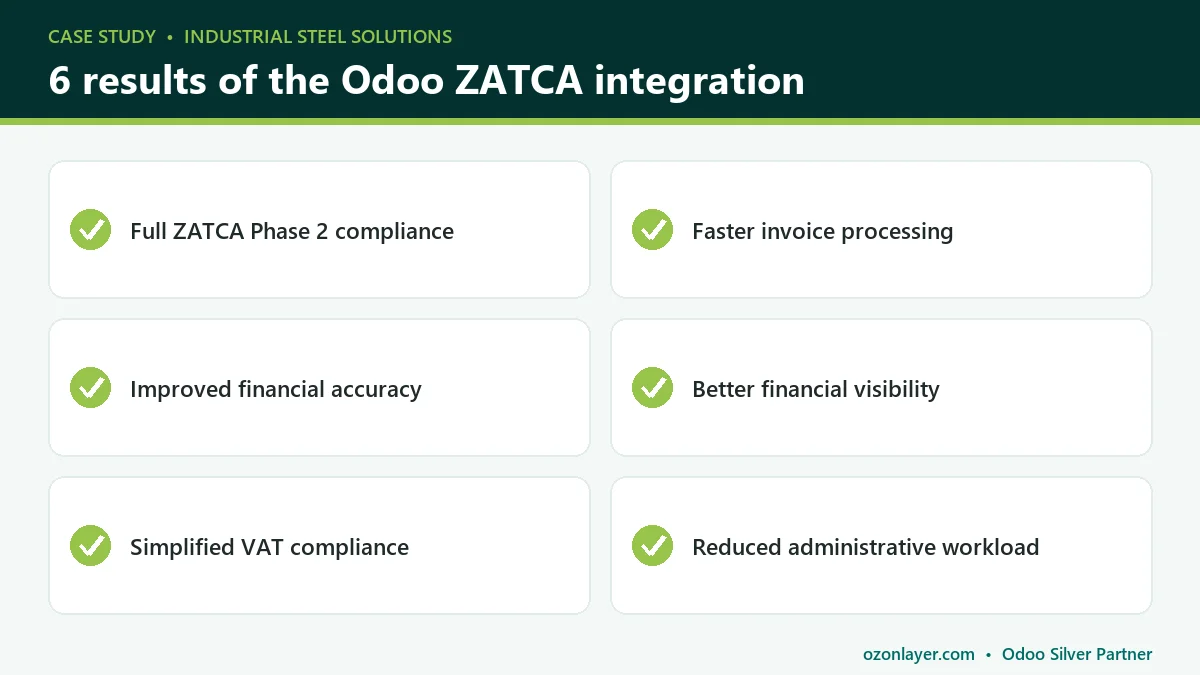
The project delivered six clear results for the company and its finance team.
Full ZATCA compliance
The company met all Phase 2 e-invoicing requirements and eliminated its compliance risks. Every customer invoice now follows the required ZATCA e-invoicing format and process.
Faster invoice processing
Invoice generation, validation and submission became fully automated, reducing processing time significantly. Invoices reach customers sooner, which supports faster collections.
Improved financial accuracy
Automation reduced manual errors and improved the reliability of financial records. When entries post automatically from source documents, there are fewer places for mistakes to creep in.
Better financial visibility
Management gained access to real-time financial information and decision-making dashboards, so credit, purchasing and cash decisions are based on current numbers.
Simplified VAT compliance
VAT calculations and reporting became more accurate and efficient, and the team spends far less effort preparing each return.
Reduced administrative workload
Accounting staff spent less time on manual tasks and more time on financial analysis and control, which is where their experience adds the most value.
| Metric | Result |
|---|---|
| ZATCA-compliant invoicing process | 100% |
Business impact
Looking at the business as a whole, the project changed how the company runs its finance function:
- 100% ZATCA-compliant invoicing process
- Automated invoice clearance and reporting
- Improved VAT compliance and audit readiness
- Faster month-end closing process
- Enhanced financial visibility and control
- Reduced manual accounting effort
- Improved cash flow monitoring
These gains build on each other. The Odoo ZATCA integration removes regulatory risk, accurate postings make the close faster, and a faster close gives management reliable numbers sooner.
Lessons for steel trading businesses considering Odoo
Every company is different, but several lessons from this project apply to most trading and distribution businesses in Saudi Arabia.
Treat compliance as part of accounting, not a separate tool
E-invoicing works best when it sits inside the system that already creates your invoices. A bolt-on tool that copies data from another system adds a second place for errors and a second thing to maintain.
Fix the process before you automate it
Automation speeds up whatever process you already have. An assessment of how invoices, credit notes and payments flow today helps you remove workarounds before they are built into the new system.
Get tax configuration right from day one
VAT rates, fiscal positions and tax accounts drive every invoice and every return. Errors here repeat on every document, so they deserve careful setup and testing before go-live.
Plan for reconciliation and reporting, not just invoicing
Compliance is the trigger for many projects, but the lasting value often comes from bank reconciliation, aging reports and real-time dashboards. Include them in scope so the finance team benefits beyond the regulatory deadline. Our ELMARK RAJAB trading and distribution case study shows how a distributor extended Odoo across operations.
Budget for training and ongoing support
Users who understand why each step matters make fewer mistakes, and compliance rules evolve. Plan for both when you estimate your Odoo implementation cost in Saudi Arabia.
Frequently asked questions
What is ZATCA Phase 2 e-invoicing?
Phase 2, the integration phase, requires taxpayers’ e-invoicing systems to connect directly with ZATCA’s FATOORA platform. Standard tax invoices for businesses must be cleared by ZATCA before they are shared with the buyer, while simplified invoices for consumers must be reported within 24 hours.
Invoices are issued as UBL 2.1 XML files with a cryptographic stamp and a QR code. ZATCA rolls the phase out to taxpayers in groups, and each group is notified in advance.
Does Odoo support ZATCA e-invoicing?
Yes. Odoo’s Saudi Arabia localization includes e-invoicing features for ZATCA, including XML generation, QR codes and the connection used for clearance and reporting. A partner still needs to configure taxes, complete onboarding and test the flow against your business processes.
What does an Odoo ZATCA integration involve?
A typical project includes a review of your current invoicing and VAT process, setup of Odoo Accounting and the Saudi localization, onboarding through the FATOORA portal to obtain CSID certificates, testing of invoices and credit notes, user training and go-live support. Our Odoo integration services cover connections with other systems as well.
Can Odoo handle credit notes under ZATCA rules?
Yes. Credit notes and debit notes are part of the e-invoicing scope and must follow the same format and clearance or reporting rules as invoices. In Odoo, a credit note is created from the original invoice, so the link between the two documents is kept.
Is Odoo suitable for steel trading and distribution companies?
Odoo suits trading and distribution businesses well because accounting, sales, purchasing and inventory can share one database. A company can start with Odoo Accounting and ZATCA e-invoicing, as in this project, and add other apps later as its needs grow.
Conclusion
Through the implementation of Odoo Accounting and ZATCA e-invoicing integration, Industrial Steel Solutions turned its financial operations into a fully automated and compliant system. The company now benefits from streamlined accounting processes, real-time financial visibility and confidence in meeting Saudi regulatory requirements.
If your business faces similar challenges with VAT, Phase 2 e-invoicing or manual accounting, OzonLayer can help you plan and deliver the right setup. Book a free Odoo consultation to discuss your requirements with our team.