
This case study shows how Odoo ERP for trading and distribution helped ELMARK RAJAB replace disconnected processes with one integrated system for sales, purchasing, inventory and accounting. ELMARK RAJAB supplies products to commercial and industrial customers, and as the company grew, manual workflows began to slow down quoting, buying, stock control and reporting.
OzonLayer, a verified Odoo Silver Partner based in Riyadh, analyzed the company’s processes, configured Odoo Sales, Inventory, Purchase and Accounting, and added management dashboards on top. Below you will find the challenges, the setup, the delivery approach and the six results the business achieved, plus practical lessons for any distributor evaluating a distribution ERP.
In this case study

Odoo ERP for trading and distribution at a glance
Here is a quick summary of the project before we go into the detail of how the Odoo ERP rollout was planned and delivered.
| Item | Details |
|---|---|
| Client | ELMARK RAJAB |
| Industry | Trading & Distribution |
| Solution | Odoo Sales, Inventory, Purchase & Accounting, with management dashboards |
| Implementation partner | OzonLayer IT Services, verified Odoo Silver Partner |
| Modules | Sales Management, Inventory Management, Purchase Management, Accounting, Management Dashboards |
| Services | Business process analysis, Odoo ERP implementation, sales and inventory configuration, procurement workflow setup, accounting integration, user training, go-live support |
About the client
ELMARK RAJAB is a trading and distribution company that specializes in supplying products to commercial and industrial customers. Business buyers like these expect accurate quotations, reliable delivery dates and correct invoices, and they tend to reorder regularly. That makes speed and accuracy across the whole order cycle a competitive factor, not just an internal concern.
As the business expanded, sales, procurement, inventory and financial operations were still being managed through disconnected processes. Each team kept its own records, so information had to be re-entered and reconciled as it moved from one department to the next. That is a common point at which a trading company starts looking for a proper distribution ERP.
To improve operational efficiency, tighten inventory control and gain real-time visibility of the business, ELMARK RAJAB partnered with OzonLayer to implement Odoo ERP.
The business challenges
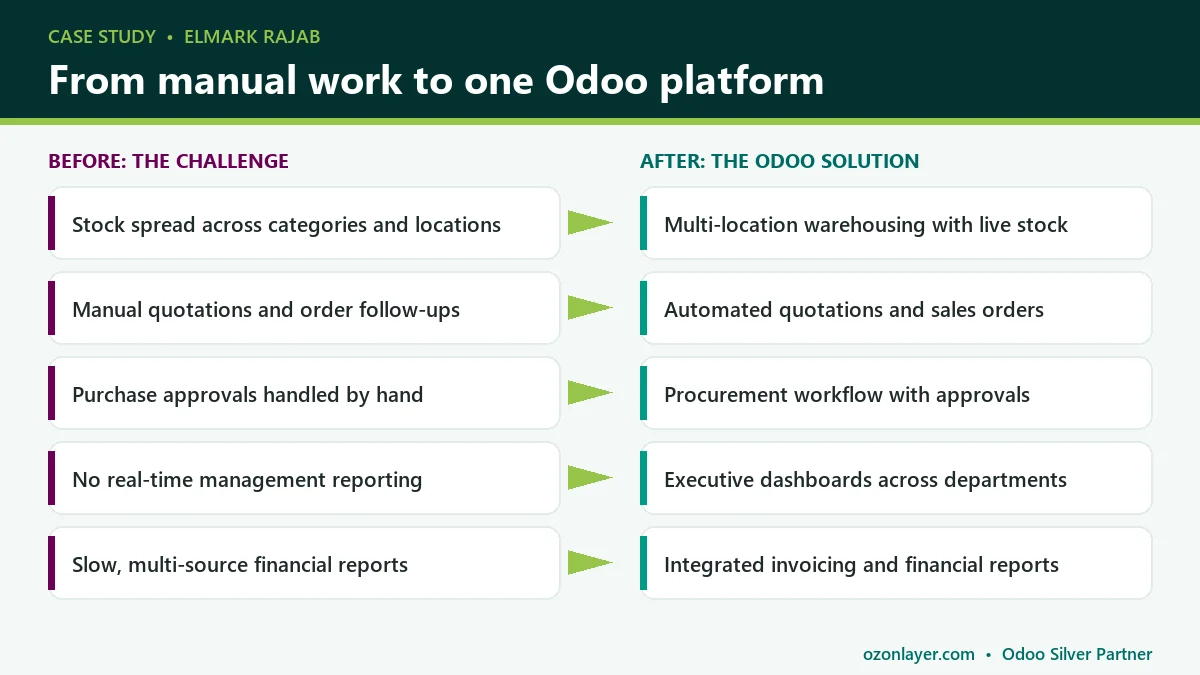
Before the project, five problems stood out. Most growing distributors will recognize at least some of them, and each one maps to a gap that a well-configured distribution ERP is designed to close.
Inventory management complexity
ELMARK RAJAB handles multiple product categories held in more than one storage location. Tracking stock across those categories and locations was difficult and prone to inaccuracies.
For a distributor, inventory is usually the largest asset on the balance sheet. When recorded stock does not match what is on the shelf, sales staff promise items that are not available, buyers reorder products the company already holds, and cash ends up tied in the wrong stock.
Manual sales processes
Sales quotations, order processing and customer follow-ups required significant manual effort. The result was delays and reduced productivity for the sales team.
Commercial and industrial customers often request several quotations before they buy. If every quote has to be assembled by hand, with prices checked separately, response times stretch and good opportunities go to faster competitors.
Procurement challenges
Purchase requests, supplier communications and order approvals were handled manually. This affected both procurement planning and supplier management.
Without a structured purchasing process, it is hard to see what has been ordered, what is awaiting approval and what is due to arrive. Planning becomes reactive, and supplier performance is difficult to measure.
Limited business visibility
Management lacked access to real-time reports on sales performance, inventory levels, procurement activities and profitability. Decisions had to wait for someone to compile the numbers.
In trading, margins can be thin and prices move. Leaders need to see which products, customers and suppliers drive profit while there is still time to act on that information.
Financial reporting delays
Producing accurate financial reports meant consolidating data from multiple sources. That increased reporting time and reduced visibility of the company’s financial position.
When accounting depends on spreadsheets passed between departments, month-end closing slows down and small errors multiply. Receivables, payables and stock valuation all become harder to trust.
Why ELMARK RAJAB chose Odoo and OzonLayer
The underlying problem was fragmentation. Every challenge above came from data living in separate places. Adding another standalone tool would not have fixed that; the company needed a single system in which a sales order, a stock movement, a purchase order and a journal entry all refer to the same records.
Odoo ERP fits that need well, which is why Odoo ERP for trading and distribution is a common choice for companies of this kind. Sales, Inventory, Purchase and Accounting are native applications built on one database, so a confirmed sales order can trigger a delivery, a low stock level can trigger a purchase, and both flow into accounting without re-entry. Because it is modular, a company can start with its core operations and add applications such as Odoo CRM later as needs grow.

Choosing the right partner matters as much as choosing the software. OzonLayer is a verified Odoo Silver Partner that implements, customizes, integrates and supports Odoo for businesses in Saudi Arabia and the UK. Our Odoo implementation services start with the client’s processes rather than a generic template, which is what a distribution ERP project needs to succeed.
What ELMARK RAJAB needed from a distribution ERP
The requirements were practical. Sales staff needed fast, accurate quotations with the right customer prices. The warehouse needed reliable stock figures across categories and locations. Purchasing needed a clear approval path and better supplier coordination. Finance needed invoices, bills and payments to post automatically, and management needed live reports rather than compiled spreadsheets.
Odoo ERP for trading and distribution covers each of these needs with standard applications, which keeps the solution easier to maintain and upgrade. Configuration, not heavy custom code, did most of the work in this project.
The solution: Odoo modules implemented
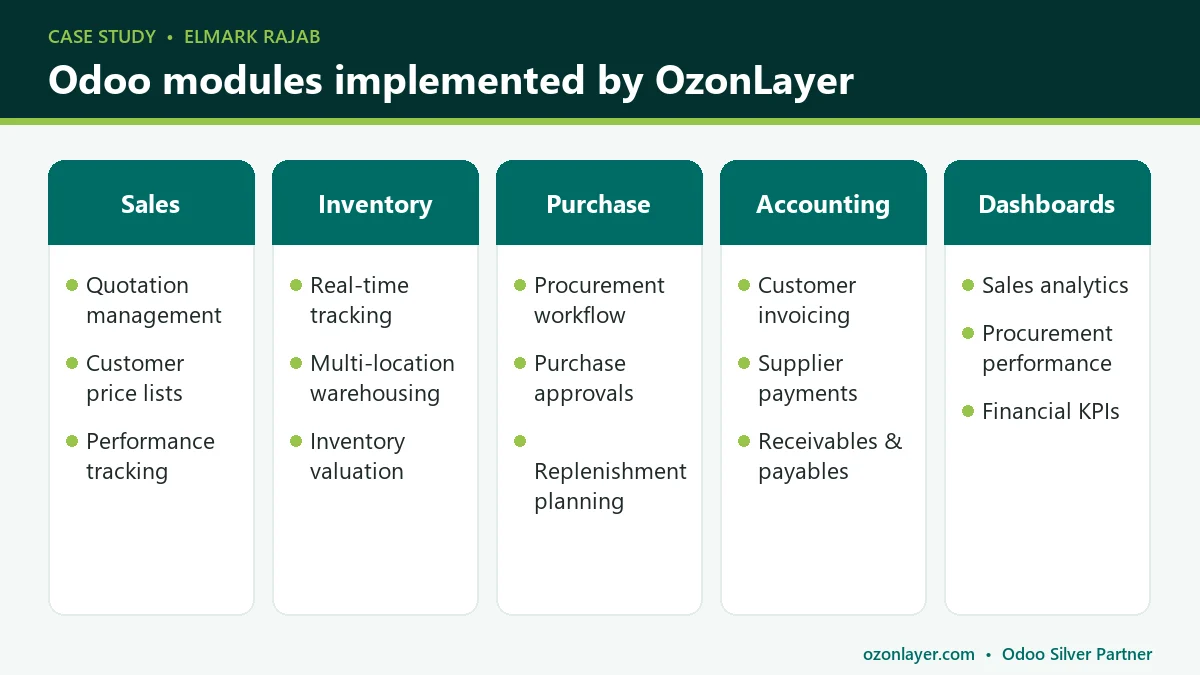
OzonLayer implemented an integrated Odoo ERP solution to centralize ELMARK RAJAB’s operations and automate key business processes. Five areas were set up to work together from day one, each sharing the same products, partners and prices inside one Odoo ERP database.
Sales management
The Odoo Sales application became the starting point of the order cycle. Quotations are built from the product catalog, priced automatically through customer price lists and sent to customers from the system. Once a customer accepts, the quotation becomes a sales order that the warehouse and finance teams can see immediately.
- Quotation management
- Sales order processing
- Customer price lists
- Sales performance tracking
Inventory management
Odoo Inventory was configured to reflect the company’s storage locations and product categories. Every receipt, internal transfer and delivery is recorded as a stock move, so on-hand quantities update as work happens. The Odoo Inventory documentation explains these warehouse and location concepts in more depth.
- Real-time inventory tracking
- Multi-location warehousing
- Inventory valuation
- Stock movement monitoring
If stock control is your main concern, our overview of Odoo inventory management software covers the features in more detail.
Purchase management
Odoo Purchase replaced manual requests and approvals with a structured workflow. Requests for quotation go to suppliers from the system, approvals follow defined rules, and confirmed purchase orders create incoming receipts automatically. In Odoo, replenishment can be planned with reordering rules that suggest or create purchases when stock falls below a set minimum.
- Automated procurement workflow
- Supplier management
- Purchase approval process
- Replenishment planning
Accounting
Odoo Accounting connects directly to sales and purchasing. Customer invoices are generated from sales orders, vendor bills can be matched against purchase orders and receipts, and payments are recorded against open balances. Because stock moves and invoices post to the same ledger, financial reports no longer require manual consolidation.
- Customer invoicing
- Supplier payments
- Financial reporting
- Accounts receivable & payable
Management dashboards
On top of the operational applications, OzonLayer set up dashboards that give management a live view of the business. They draw on the same records the teams use every day, so the figures are always current without anyone compiling them.
- Sales analytics
- Inventory reports
- Procurement performance
- Financial KPIs
Key features implemented
Beyond the individual applications, five capabilities define how the new distribution ERP works for ELMARK RAJAB.
Centralized business operations
Sales, procurement, inventory and accounting were integrated into a single ERP platform. This eliminated duplicate data entry and improved collaboration, because every team now works from the same customer, product and transaction records.
Real-time inventory visibility
Management gained instant access to stock availability, inventory valuation and product movement information. Sales staff can check availability before they commit to a customer, and buyers can see what is already on order.
Automated procurement process
Purchase workflows were streamlined to improve approval cycles and supplier coordination. Requests no longer wait in inboxes, and each purchase order carries a clear status from request to receipt.
Customer and supplier management
A centralized database enabled better management of customer accounts, supplier records and transaction history. Anyone with the right access can see a partner’s quotations, orders, deliveries, invoices and payments in one place.
Executive dashboards
Customized dashboards provide real-time insight into operational and financial performance. Leaders can move from a summary figure down to the underlying orders or invoices when they need to understand a trend.
Implementation approach
OzonLayer delivered the project in clear stages, with ELMARK RAJAB’s team involved throughout. These are the services we provided.
- Business process analysis. We started with discovery workshops to map how quotations, orders, purchases, stock and accounting actually flowed, and where data was being re-entered or delayed.
- Odoo ERP implementation. Based on that analysis, we set up the Odoo environment and the core configuration shared by all applications, such as company settings, users and access rights.
- Sales and inventory configuration. We configured products, categories, price lists, warehouses and storage locations so the system mirrors how the business sells and stores goods.
- Procurement workflow setup. We built the purchasing flow, including supplier records, approval steps and replenishment planning.
- Accounting integration. We connected sales, purchasing and inventory to accounting so that invoices, bills, payments and stock valuation post to the ledger.
- User training. Each team was trained on the processes they own, using their own day-to-day scenarios rather than generic demos.
- Go-live support. We supported users as they moved onto the new system, answering questions and resolving issues while new habits formed.
This sequence matters. Analysis before configuration keeps the distribution ERP aligned with real work, and training before go-live means users arrive on day one already familiar with their screens. Go-live support then catches the small issues that only appear once real orders, receipts and invoices start flowing through Odoo ERP.
Where a business needs more than standard configuration, our Odoo customization services can extend the system without breaking upgrade paths.
Results achieved
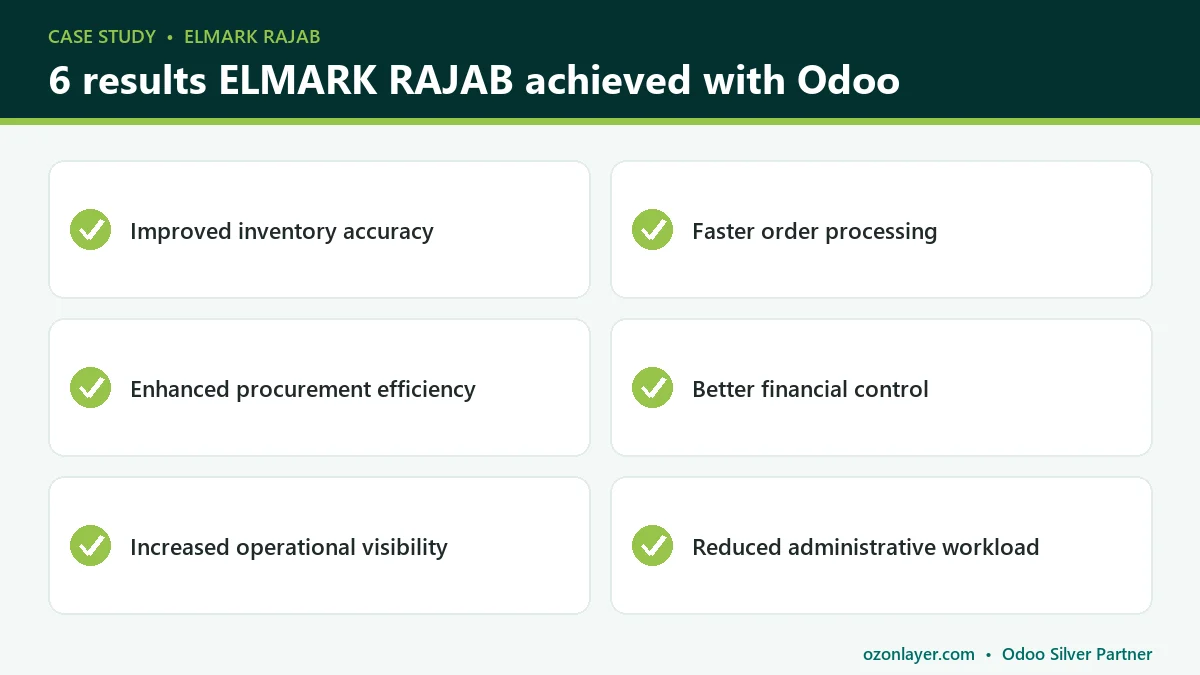
After go-live, ELMARK RAJAB reported six clear improvements across its operations. Each one traces back to a challenge the new distribution ERP was designed to solve.
1. Improved inventory accuracy
Real-time inventory tracking reduced stock discrepancies and improved warehouse control.
2. Faster order processing
Automation enabled quicker quotation generation, order confirmation and delivery processing.
3. Enhanced procurement efficiency
Streamlined purchasing workflows improved supplier management and procurement planning.
4. Better financial control
Integrated accounting provided accurate and timely financial information for management.
5. Increased operational visibility
Management gained access to comprehensive reports and dashboards for informed decision-making.
6. Reduced administrative workload
Automation minimized manual data entry and repetitive administrative tasks, freeing staff to focus on customers and suppliers.
Business impact
Taken together, these results changed how the company runs day to day. With Odoo ERP in place, the business now has:
- Centralized management of sales, inventory, procurement and finance
- Improved inventory visibility and stock control
- Faster sales and purchasing cycles
- Better supplier and customer management
- Real-time operational and financial reporting
- Increased efficiency and business transparency
- A scalable platform supporting future business growth
Lessons for trading and distribution businesses considering Odoo
Every company is different, but these practical takeaways apply to most distributors planning an Odoo ERP project.
Map processes before choosing settings
Software configuration should follow the way your business sells, buys and stores goods. A short process analysis up front prevents expensive rework later and exposes steps that can be removed entirely.
Treat inventory as the backbone
In distribution, almost every transaction touches stock. Get locations, product categories and units of measure right first, and sales, purchasing and accounting will rest on reliable data. Our article on the benefits of Odoo inventory management explains why.
Connect purchasing to demand
Reordering rules and replenishment planning turn purchasing from guesswork into a routine. Combined with clear approval steps, they keep stock levels healthy without tying up excess cash. The Odoo Purchase documentation is a useful reference here.
Look at the full supply chain
Many distributors gain the most by viewing sales, warehousing and purchasing as one chain. Our guide to supply chain management software covers how Odoo links these steps.
Choose a distribution ERP that can grow with you
A system that only fixes today’s problems will need replacing in a few years. Odoo ERP lets you add applications, users and warehouses over time without changing platforms, so the investment keeps paying back as the company expands into new product lines or markets.
Invest in training, not just configuration
Even the best distribution ERP fails if people keep their old spreadsheets. Role-based training built on real daily scenarios, followed by support in the first weeks after go-live, is what turns a configured system into a working habit.
Plan for compliance early
If you invoice in Saudi Arabia, e-invoicing requirements should be part of the design from the start. The Industrial Steel Solutions ZATCA case study shows how this can be handled in Odoo.
Frequently asked questions
Is Odoo ERP for trading and distribution suitable for growing companies?
Yes. Odoo ERP is modular, so a distributor can start with Sales, Inventory, Purchase and Accounting and add applications as the business grows. All applications share one database, which avoids the integration problems that come with combining separate tools.
How does Odoo ERP handle purchase approvals?
Odoo Purchase can require approval for orders, for example above a defined amount, before they are confirmed. Approved orders then create incoming receipts automatically, and vendor bills can be checked against the order and the received quantities.
Can a distribution ERP apply different prices per customer?
Yes. In Odoo ERP, price lists let you set prices by customer, customer group, quantity or period. When a salesperson creates a quotation, the correct price is applied automatically, which reduces errors and speeds up quoting.
What does a distribution ERP implementation with OzonLayer involve?
A typical project includes business process analysis, configuration of the relevant Odoo applications, workflow setup, accounting integration, user training and go-live support. The exact scope depends on your processes, which is why we start with a consultation.
How is a distribution ERP different from basic accounting software?
Accounting software records the financial result of transactions. A distribution ERP manages the transactions themselves, from quotation and purchase order to stock movement and delivery, and posts the accounting automatically. That is what gives management a live, consistent picture of the whole business.
Conclusion
Through a successful Odoo ERP implementation, ELMARK RAJAB transformed its operations into a fully integrated, data-driven environment. The company now benefits from improved inventory control, streamlined procurement, better financial visibility and greater operational efficiency.
The new system gives the business a strong foundation for continued growth and lets management make faster, better-informed decisions. It shows what Odoo ERP for trading and distribution can deliver when processes, configuration and training are handled together.
If your company is facing similar challenges, book a free Odoo consultation with our team. We will review your current processes and recommend the right Odoo setup for your business.