
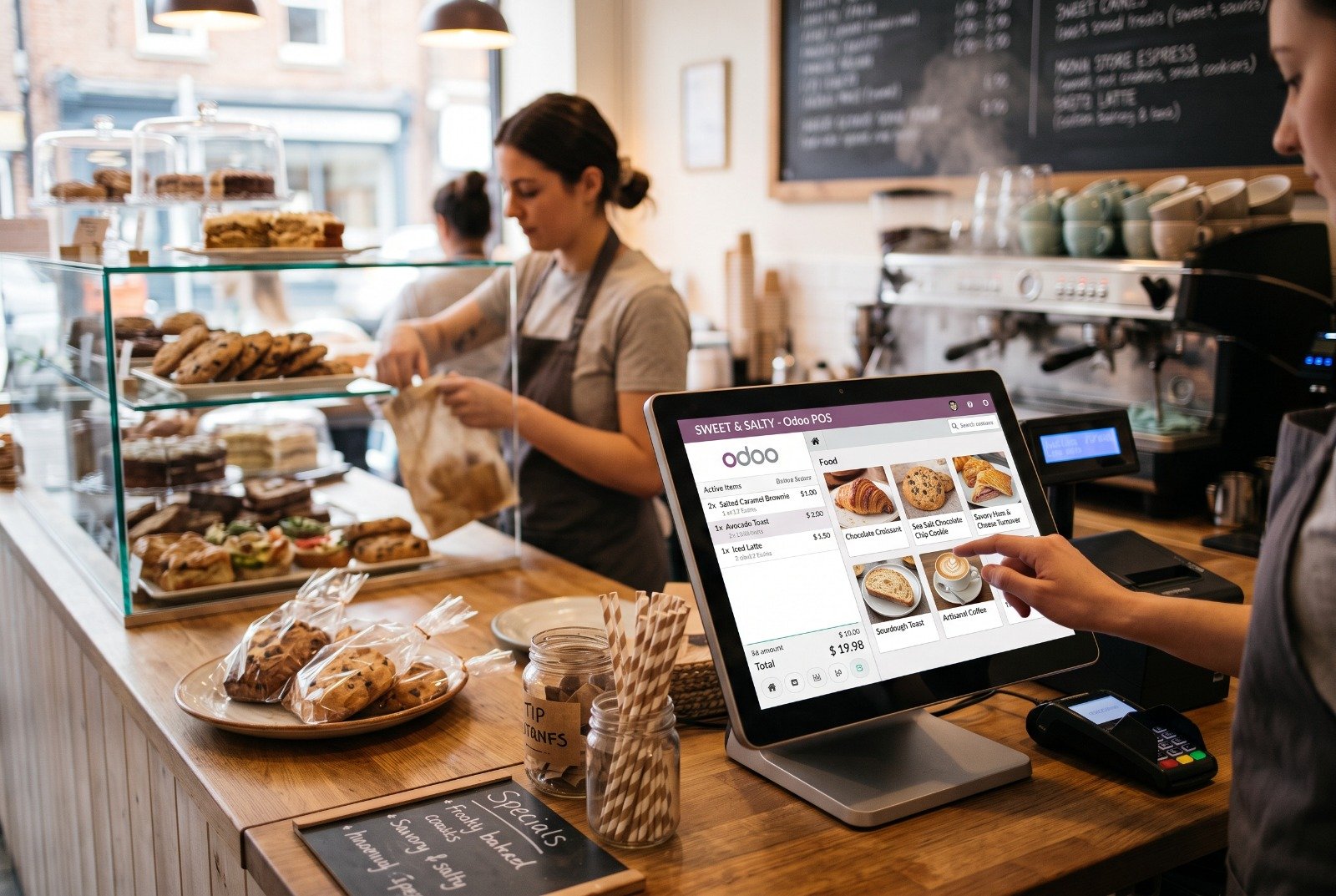
This case study shows how Odoo POS for restaurants helped Sweet & Salty, a growing food and beverage business, replace manual cashier work with one connected system for sales, ingredients, purchasing and accounting. Sweet & Salty serves fresh meals, salads and takeaway, and as demand grew, the team needed tighter control over every order, every ingredient and every cost line.
Working with OzonLayer, a verified Odoo Silver Partner, Sweet & Salty moved to an integrated restaurant ERP built on Odoo Point of Sale, Inventory, Purchase and Accounting, with management dashboards on top. The reported results include a 30% reduction in food waste, 50% faster cashier transactions and a 40% improvement in inventory accuracy. Below we explain the challenges, the setup, the delivery approach and what other restaurant owners can learn from it.
In this case study

Odoo POS for restaurants: Sweet & Salty at a glance
| Item | Details |
|---|---|
| Client | Sweet & Salty |
| Industry | Food & Beverage / Restaurant |
| Solution | Odoo POS, Inventory, Purchase & Accounting |
| Implementation partner | OzonLayer IT Services (verified Odoo Silver Partner) |
| Modules | Point of Sale, Inventory Management, Purchase Management, Accounting, Management Dashboards |
| Services | Business process analysis, Odoo POS implementation, inventory configuration, accounting setup, user training, go-live support |
| Headline results | 30% reduction in food waste; 50% faster cashier transactions; 40% improvement in inventory accuracy; real-time visibility into daily profitability; 60% reduction in manual reporting effort |
About the client
Sweet & Salty is a food and beverage business that specializes in fresh meals, salads and takeaway services. Its menu depends on perishable ingredients, quick service at the counter and a steady flow of supplies, which makes daily control of sales and stock essential.
As customer demand increased and operations expanded, the business outgrew its manual processes. Sales, stock, purchasing and finance were handled separately, and management could not see the whole picture in one place. To support growth and improve operational control, Sweet & Salty partnered with OzonLayer to implement Odoo ERP as a single, centralized system.
The business challenges
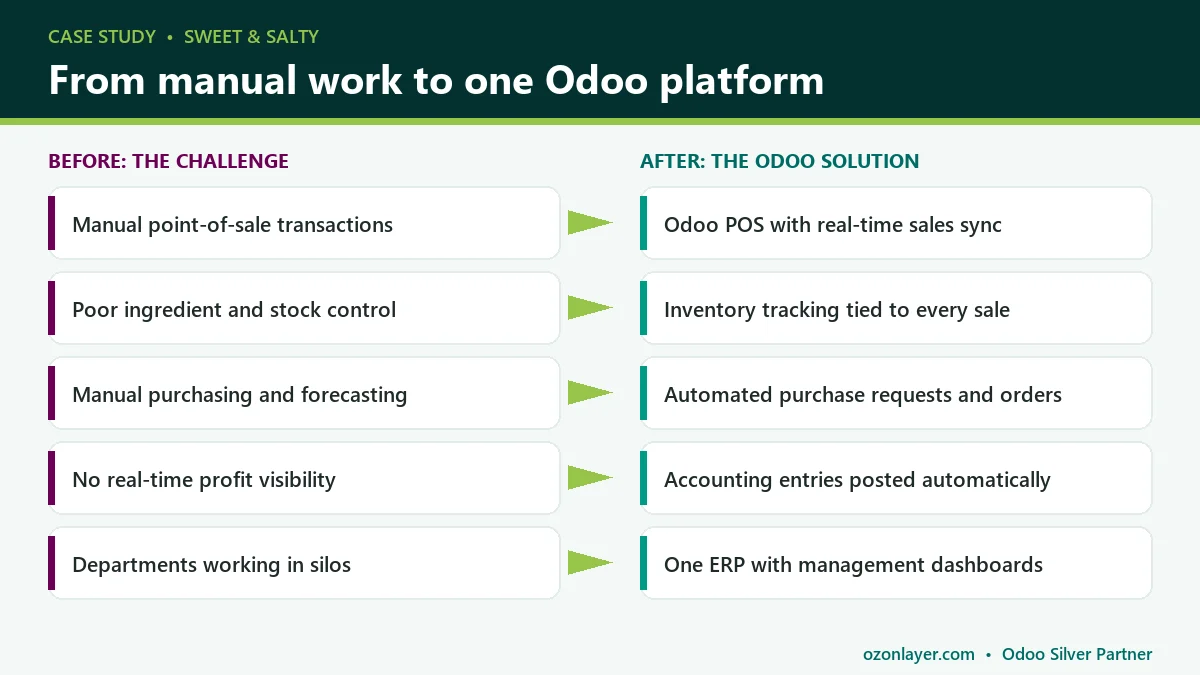
Before the project, Sweet & Salty faced five connected problems. Each one is common in growing restaurants, and together they made it hard to control costs while serving more customers.
Manual point of sale operations
Sales transactions were processed manually. That made it difficult to track daily revenue, cashier performance and branch sales accurately. End-of-day totals had to be pieced together by hand, and there was no reliable way to compare one shift or cashier with another.
For a restaurant, the till is the first source of truth. If sales are not captured cleanly at the counter, every downstream number, from ingredient usage to profit, is a guess. This is why most projects of this kind begin with Odoo POS before anything else.
Inventory control issues
The business struggled to monitor ingredient consumption, stock levels and inventory valuation. The result was a mix of stock shortages on some items and unnecessary wastage on others.
Fresh produce, dairy and proteins have short shelf lives. When a kitchen cannot see what it actually used against what it sold, it tends to over-order to stay safe, and the surplus ends up in the bin. Shortages, on the other hand, mean menu items go unavailable and sales are lost.
Procurement management
Purchasing was managed manually, which made it difficult to forecast demand and keep inventory at the right level. Orders depended on someone checking shelves and remembering what to buy.
Manual purchasing also makes it hard to compare suppliers, track what was ordered against what arrived, and plan ahead for busy periods. In food service, those gaps show up quickly as waste or stock-outs.
Limited financial visibility
Management lacked real-time access to sales performance, operational costs and profitability reports. By the time numbers were compiled, decisions about menu, staffing or purchasing had already been made.
Restaurant margins are thin, so food cost and labor need to be watched closely. Without timely reports, owners cannot see which products earn money and which quietly lose it.
Multi-department coordination
Sales, inventory, purchasing and accounting ran independently. The same information was entered more than once, efforts were duplicated and reports were delayed.
When each team keeps its own records, numbers rarely match. Time goes into reconciling spreadsheets instead of improving service. A restaurant ERP solves this by giving every department the same live data, so a sale, a delivery and a journal entry all describe the same event.
Why Sweet & Salty chose Odoo and OzonLayer
Sweet & Salty needed one platform that could run the counter, the stockroom, purchasing and the books together. Odoo fits that need because its apps share a single database. A sale rung up in Odoo POS updates stock, and stock movements and purchases feed straight into accounting without re-entry.
That shared foundation is what separates a true restaurant ERP from a standalone till. A standalone POS records the sale; an integrated system also tells you what the sale cost, what needs reordering and how the day affected profit.
Odoo is also modular. A food business can start with the apps it needs most and add more later without changing platforms. For Sweet & Salty, that meant a focused scope: Odoo POS at the counter, Inventory and Purchase behind it, Accounting underneath and dashboards for management. Choosing Odoo POS for restaurants in this way keeps the first phase practical while leaving room to grow.
The business chose OzonLayer as its implementation partner. OzonLayer is a verified Odoo Silver Partner based in Riyadh that implements, customizes, integrates and supports Odoo for businesses in Saudi Arabia and the UK. You can view the OzonLayer profile on the official Odoo partner directory. For a broader view of how we deliver projects, see our Odoo implementation services in Saudi Arabia.
The solution: Odoo modules implemented
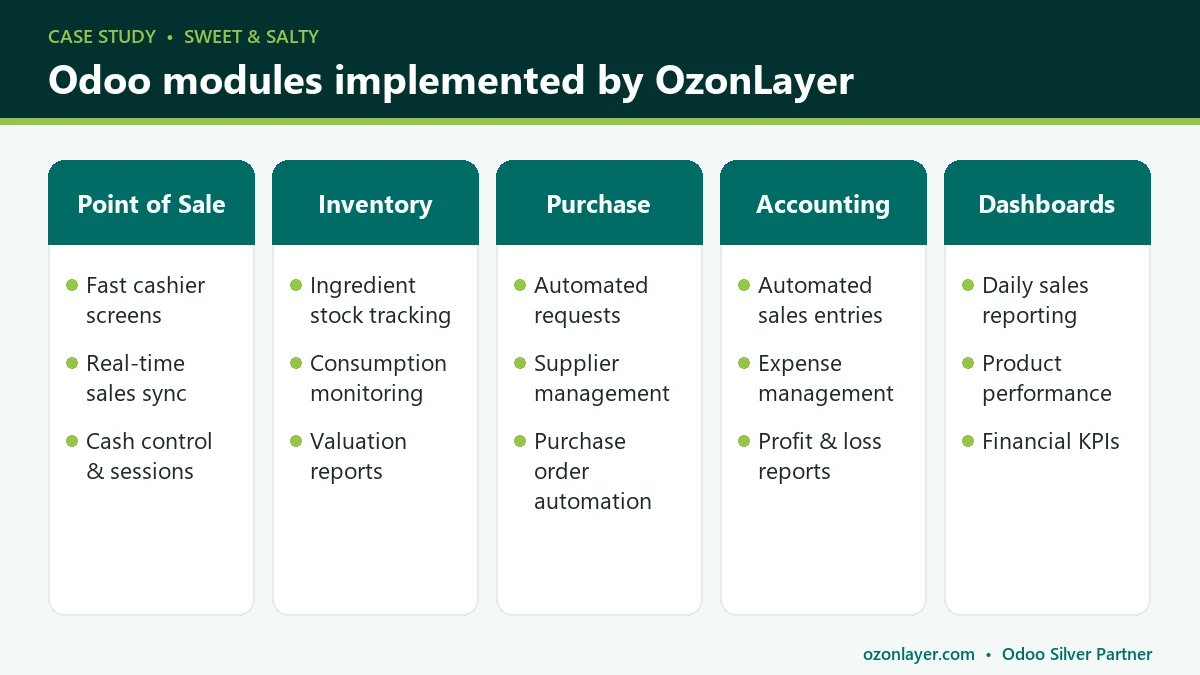
OzonLayer implemented an integrated Odoo ERP solution to automate restaurant operations and give real-time visibility across the business. Five areas were configured to work as one system, with Odoo POS feeding data to every other app.
Odoo Point of Sale (POS)
The counter was the starting point. Odoo POS was set up with product categories and pricing so cashiers could find items quickly and charge the right amount every time. Each shift runs inside a POS session that opens with a cash count and closes with a reconciliation, so differences are visible straight away. Sales sync to the back office in real time. The official Odoo Point of Sale documentation explains how sessions and cash control work.
- Fast and user-friendly cashier operations
- Real-time sales synchronization
- Product categories and pricing management
- Cash control and session management
Inventory management
Inventory was configured to track ingredients, not just finished menu items. Consumption is updated from sales, stock levels are visible at any time, and valuation reports show what the stock on hand is worth. Replenishment is managed from actual levels rather than guesswork. Learn more about our Odoo inventory management software setup for food and retail businesses.
- Ingredient stock tracking
- Inventory consumption monitoring
- Stock replenishment management
- Inventory valuation reports
Purchase management
Purchasing moved from memory and phone calls to a structured process. Purchase requests are generated automatically, supplier details are kept in one place and purchase orders follow a consistent flow. This links buying decisions to real consumption data. The Odoo Purchase documentation covers how requests, orders and vendor records connect.
- Automated purchase requests
- Supplier management
- Procurement planning
- Purchase order automation
Accounting
Accounting was set up so sales and purchases post automatically. When a POS session closes, its entries flow into the books. Expenses are recorded in the same system, and financial reports, including profit and loss, are available without manual consolidation. Our Odoo accounting software page explains this setup in more detail.
- Automated sales entries
- Expense management
- Financial reporting
- Profit and loss reporting
Management dashboards
Dashboards bring the data together for owners and managers. Instead of waiting for reports, management can open a single view of daily sales, product performance, stock and financial results. Because the figures come straight from Odoo POS, Inventory and Accounting, the dashboards show the same numbers the teams work with every day.
- Daily sales reporting
- Product performance analysis
- Inventory monitoring
- Financial performance tracking
Key features implemented
Beyond the individual modules, five features made the biggest difference to day-to-day work at Sweet & Salty.
Integrated restaurant operations
Sales, inventory, purchasing and accounting processes were connected within a single ERP platform. Staff work from the same records, so there is no need to copy figures from one system into another. This is the core value of a restaurant ERP: one version of the truth for the whole team.
Real-time sales monitoring
Management gained immediate visibility into daily sales performance and revenue trends. They can see how the day is going while it is still happening, not the next morning. Each Odoo POS session adds to the picture as orders are rung up.
Inventory consumption tracking
Ingredient and inventory usage is updated automatically from sales transactions, which improves stock accuracy. Every order rung up in Odoo POS reduces the stock of the items it uses, so on-hand figures stay close to reality.
Automated financial management
Sales and purchasing transactions flow directly into accounting, reducing manual bookkeeping. The finance team reviews and reconciles rather than retyping.
Business performance reporting
Customized dashboards let management monitor operational and financial KPIs in real time. Key numbers are on one screen instead of scattered across files.
Implementation approach
OzonLayer delivered the project through a structured sequence of services. Each step built on the one before it, so the system matched how the restaurant actually works. The aim was not simply to install software but to make the restaurant ERP fit daily routines at the counter, in the stockroom and in the back office.
- Business process analysis. We started by mapping how Sweet & Salty sold, stocked, bought and reported. Workshops with the team identified where manual steps caused delays, errors or waste, and set out how each process would run in Odoo.
- Odoo POS implementation. The point of sale was configured with product categories, pricing, sessions and cash control so the counter could run quickly and every sale would be captured cleanly.
- Inventory configuration. Ingredients, stock locations, consumption tracking, replenishment and valuation were set up so sales would update stock automatically.
- Accounting setup. Accounts, journals and automatic posting rules were configured so sales, purchases and expenses flow into financial reports without re-entry.
- User training. Cashiers, store staff, purchasing and finance users were trained on the tasks they perform every day. Our Odoo training services focus on real workflows rather than generic menus.
- Go-live support. OzonLayer supported the team as the system went live, helping users with early questions and fine-tuning settings once real orders were flowing.
The same method applies to most hospitality projects. If you are budgeting for a similar rollout, our guide to Odoo implementation cost explains the main factors that drive scope and price.
Results achieved
After go-live, Sweet & Salty reported clear gains across sales, stock, finance and management. The results below show what Odoo POS for restaurants can deliver when it is connected to inventory, purchasing and accounting rather than used as a till alone.
Improved sales visibility
Management gained real-time sales information, which helped identify peak business periods and best-selling products. That supports better decisions on staffing, prep and menu focus. Sales reports in Odoo POS can be filtered by product, category, session and cashier, which makes these patterns easy to spot.
Better inventory control
Automated stock tracking reduced shortages and improved inventory planning. The kitchen knows what it has and what it needs before service starts.
Reduced food waste
Better visibility into inventory consumption helped optimize purchasing decisions and minimize wastage. Buying is now based on what is actually used, not on habit.
Faster financial reporting
Integrated accounting gave quicker access to financial statements and profitability reports, because the data is already in the books when the day closes.
Increased operational efficiency
Automation reduced manual administrative work and improved staff productivity. Time that went into data entry and reconciliation can go back into service.
Enhanced decision making
Real-time reporting helps management make informed business decisions based on accurate data rather than estimates. With a restaurant ERP in place, questions about menu pricing, supplier choice or staffing can be answered from live figures.
The table below lists the KPI figures Sweet & Salty reported after moving to Odoo.
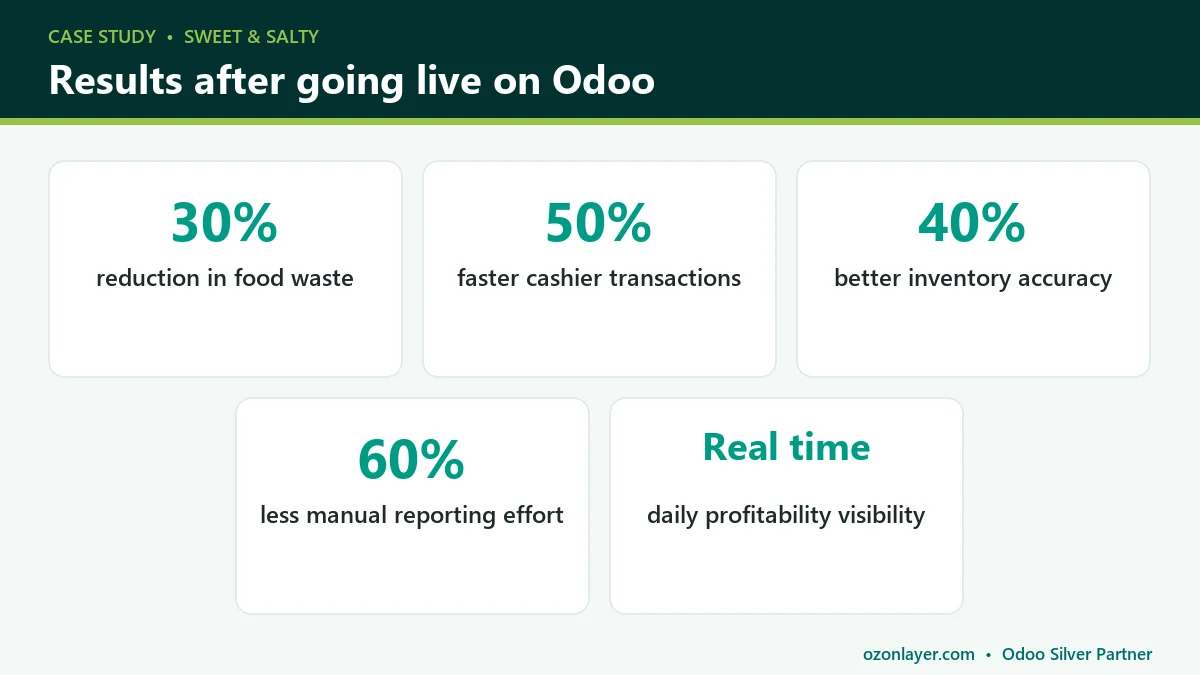
| Metric | Result |
|---|---|
| Food waste | 30% reduction |
| Cashier transactions | 50% faster |
| Inventory accuracy | 40% improvement |
| Daily profitability | Real-time visibility |
| Manual reporting effort | 60% reduction |
Business impact
Taken together, the project changed how Sweet & Salty runs from the counter to the balance sheet:
- Centralized management of restaurant operations
- Improved inventory accuracy and stock control
- Faster sales and cashier operations
- Better procurement planning
- Real-time profitability monitoring
- Reduced manual work and reporting delays
- Scalable platform for future expansion
The last point matters for any growing food business. Because the system is built on standard Odoo apps, new menu items, suppliers or locations can be added within the same platform. Our Match Perfumes multi-branch retail case study shows how the same foundation supports a business across several stores.
Lessons for restaurants considering a restaurant ERP
Every restaurant is different, but several lessons from this project apply to most cafés, takeaway outlets and food chains evaluating Odoo POS for restaurants or a wider restaurant ERP.
- Start at the till. Clean sales data is the base for everything else. Set up product categories, prices and cash control in Odoo POS before worrying about advanced reports.
- Track ingredients, not just dishes. Waste and food cost live at ingredient level. Linking menu items to the ingredients they consume is what turns sales into accurate stock figures.
- Connect purchasing to consumption. Reordering based on real usage, rather than habit, is one of the most direct ways to reduce both shortages and spoilage.
- Let accounting post automatically. When sales and purchases flow into the books, finance can focus on review and analysis rather than data entry.
- Train by role. Cashiers, storekeepers and accountants need different skills. Short, role-based training gets people confident faster.
- Plan for growth. Choose a platform that can add locations, menus and users without a new system each time.
None of these steps require a large IT team. What they require is a clear view of current processes and a partner who knows how a restaurant ERP should be configured for food service, from the POS screen to the profit and loss report.
Frequently asked questions
What does Odoo POS for restaurants include?
Odoo’s Point of Sale app covers the counter: product categories, pricing, payment methods, sessions with opening and closing cash counts, and receipts. Odoo also offers restaurant-specific options such as floor plans, table management and kitchen order printing or screens, which a business can enable depending on how it serves customers.
Because Odoo POS shares a database with Inventory and Accounting, each sale can update stock and post to the books automatically. That integration is what makes Odoo POS for restaurants more than a cash register.
How is a restaurant ERP different from a standalone POS?
A standalone POS records sales. A restaurant ERP connects those sales to ingredients, purchasing, suppliers and accounting, so the business can see food cost, stock levels and profit in one place. That connection removes double entry and gives managers numbers they can act on the same day.
In Odoo, the POS is one app among many, so a restaurant ERP built on it can grow from the counter into purchasing, accounting and reporting without moving data between systems.
Can Odoo track ingredient consumption from sales?
Yes. In Odoo, menu items can be linked to the ingredients they use, so each sale reduces the relevant ingredient stock. Combined with stock counts and valuation reports, this shows where actual usage differs from expected usage, which is often where waste hides.
Does Odoo help with purchasing for restaurants?
Odoo Purchase manages suppliers, purchase requests and purchase orders. Reordering rules in Inventory can suggest or create orders when stock falls below a minimum level. The Odoo Inventory documentation explains how replenishment works.
How do I start an Odoo POS project for my restaurant?
Begin with a short process review covering how you sell, stock, buy and report today. From there, a partner can recommend which apps to configure and in what order. Most restaurants start with Odoo POS and Inventory, then add Purchase and Accounting. You can read about our Odoo POS system in Saudi Arabia or contact OzonLayer to discuss your requirements.
Conclusion
Through the implementation of Odoo ERP, Sweet & Salty turned its restaurant operations into a fully integrated, data-driven environment. The business now benefits from streamlined sales processing, improved inventory management, better financial visibility and greater operational efficiency.
The solution gives Sweet & Salty a solid foundation for growth, helps management deliver a better customer experience and keeps tighter control over business performance. With 30% less food waste, 50% faster cashier transactions, a 40% improvement in inventory accuracy, real-time visibility into daily profitability and a 60% reduction in manual reporting effort, the case for Odoo POS for restaurants is easy to see.
If your restaurant, café or takeaway is still running on manual tills and spreadsheets, OzonLayer can help you plan the right setup. Book a free Odoo consultation and we will review your processes and recommend a practical path forward.