
Odoo Partner · eCommerce
Odoo for eCommerce: Online Store, Stock, Payments and Accounting in One ERP
Odoo for eCommerce runs your online store on the same database as your stock, orders, payments and accounts, so a sale on the website updates the warehouse and the books without anyone retyping it. OzonLayer, an Odoo Partner, sets it up for online-first brands, retailers adding a web shop and B2B suppliers taking orders online, across the UK, Saudi Arabia, the UAE and Pakistan.
We configure Website and eCommerce for the storefront, Sales and Inventory for orders and fulfilment, Accounting for invoices and payment matching, Point of Sale where you also sell in store, and connectors for payment providers and carriers. Already selling on Salla? We can connect your store to Odoo instead of replacing it.
50+
Odoo clients served
Web + POS
One catalogue online and in store
4
Markets: UK, KSA, UAE and Pakistan
eCommerce
What we set up for online sellers
- Odoo storefront with catalogue, variants and checkout
- Live stock online, with out-of-stock rules
- Payment providers and carrier connectors
- Automatic invoices once payment is registered
- Portal returns with reasons and refunds
- Salla orders synced into Odoo if you keep Salla
Odoo Partner · certified Odoo consultants · Updated November 2026
At a glance
What Is Odoo for eCommerce?
Odoo for eCommerce is the Odoo ERP set up for online selling: the Website and eCommerce apps run the storefront, while Sales, Inventory and Accounting handle each order, its stock and its invoice in the same database. Online stock, deliveries and payments stay in step, instead of being copied between a shop platform, spreadsheets and accounting software.
It suits brands selling on their own site, retailers adding an online shop and B2B suppliers taking trade orders online. Sellers who keep Salla can connect it to Odoo instead, as Match Perfumes did. OzonLayer handles setup, data migration, training and support. For the feature detail, see Odoo’s eCommerce documentation.
Who it suits
Online-first brands, shops adding eCommerce on the same stock, and B2B suppliers that want invited trade customers to order online at their own prices.
Core Odoo apps
Website and eCommerce, Sales, Inventory and Accounting, plus Point of Sale, Barcode, Purchase, Email Marketing, payment providers and carrier connectors where you need them.
Typical timeline
It depends on catalogue size, channels and connectors. A single store on standard apps is a much shorter project than a multi-channel rollout with e-invoicing, which goes live in stages.
Proven result
Match Perfumes runs its branches and its Salla store on one Odoo database: Salla orders flow into Odoo and stock changes flow back to the store.
Odoo services for eCommerce
Odoo for eCommerce: Services for Online Stores and Brands
From a first online shop to a brand selling on its own site, in stores and through Salla, one team of certified Odoo consultants takes your Odoo for eCommerce project from scoping to the weeks after launch. Pick a single service below, or bundle several under one plan, one budget and a single contact.

Odoo Implementation for eCommerce
A full rollout of storefront, catalogue, checkout, payment providers, delivery methods, stock rules and accounting, tested with real orders before your domain points to the new shop.
Explore implementation →

Odoo Consulting for eCommerce
Advice on whether Odoo should run your storefront or sit behind Salla or another platform, plus edition, hosting and the order in which your sales channels go live.
Explore consulting →

Odoo Development for eCommerce
Custom modules for storefront features, order rules and connectors that Odoo does not cover as standard, written on the Odoo framework so later upgrades stay manageable.
Explore development →

Odoo Customisation for eCommerce
Product page layouts, extra product attributes, checkout fields, order emails and sales dashboards adjusted to your catalogue and the way your team works.
Explore customisation →

Odoo Integration for eCommerce
Connect Odoo with Salla, payment providers, carriers and shipping aggregators, Google Merchant Center product feeds and your bank, using Odoo’s own connectors or its API.
Explore integration →

Odoo Migration for eCommerce
Move products, variants, images, customers and open orders from your current platform, spreadsheets or an older Odoo version, checked in a test copy before switch-over.
Explore migration →

Odoo Support for eCommerce
Help after launch with failed payments, stuck orders, stock mismatches, new promotions, tax queries and version upgrades, from the people who built your shop.
Explore support →

Odoo Training for eCommerce
Sessions for store managers, warehouse staff, customer service and accounts, plus admin training so you can publish products, edit pages and run promotions yourself.
Explore training →
eCommerce challenges
Why Do Growing Online Stores Oversell and Lose Track of Margin?
Most online sellers run the storefront, the stock list and the accounts in separate tools, so every order has to be copied between them. Each copy is a chance to sell stock you no longer hold, miss a refund or post a payment to the wrong account.
Whether you sell on your own website, on Salla or through several channels at once, the same four gaps tend to appear as order volumes grow. They are the gaps Odoo for eCommerce is set up to close.
Overselling across channels
The website, the shop floor and any other channel each keep their own count, so the last unit can sell twice and customer service spends the morning cancelling orders.
Orders keyed in twice
Staff copy online orders into the stock or accounting system by hand, which slows dispatch at busy times and leaves errors in addresses, quantities and prices.
Payouts that do not match
Payment providers pay out in batches, net of their fees, so finance struggles to match each deposit to the orders behind it or to see the true cost of every sale.
Returns tracked nowhere
Returns arrive by email or phone, refunds are issued outside the books and returned goods are not put back into stock, so stock and margin figures drift further each month.
Odoo apps for eCommerce
Which Odoo Apps Run an Online Store End to End?
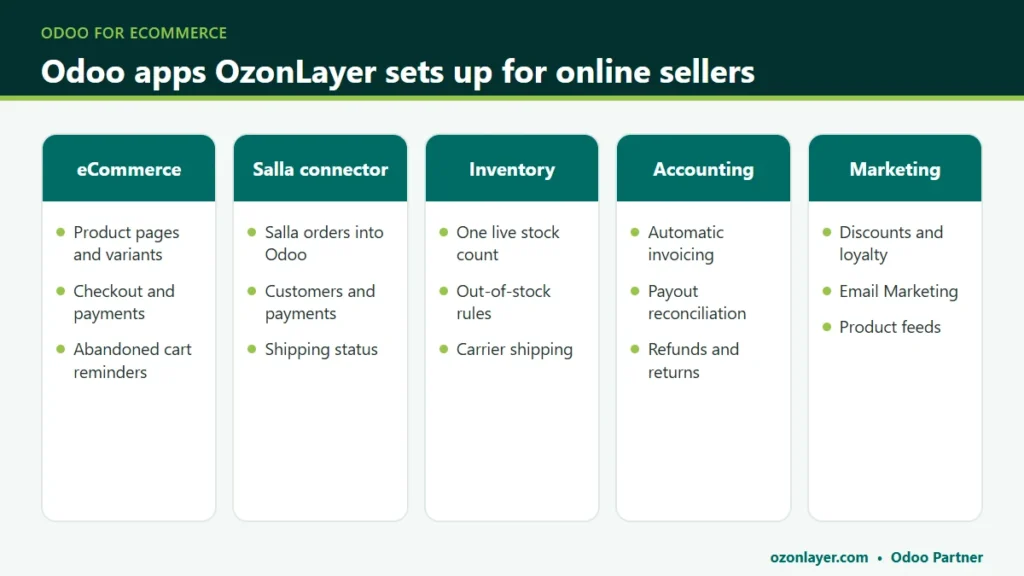
Website and eCommerce for the storefront, with Sales, Inventory and Accounting behind it, cover the core of most online businesses. A paid order reserves stock, creates the delivery and produces the invoice in one database, so the warehouse and finance see the same order the customer placed.
Around that core we add what your model needs: Point of Sale when you also trade in shops, Barcode for picking and packing, Purchase for replenishment and Email Marketing for campaigns. If your storefront stays on Salla, our Salla Odoo integration brings each Salla order, customer and payment method into Odoo instead.
Storefront and checkout
Odoo eCommerce gives you product pages with variants and categories, tax-included prices for consumers or price lists for invited trade customers, a configurable checkout and a customer portal where buyers see their orders, invoices and downloadable files.
Stock, delivery and fulfilment
The shop reads stock from the warehouse you choose, can show the remaining quantity and can block out-of-stock orders. Odoo connects to carriers such as DHL, FedEx and UPS or aggregators such as Sendcloud, and Click & Collect lets shoppers pick up in store.
Payments, invoices and returns
Odoo’s payment providers include Stripe, Adyen, PayPal and Amazon Payment Services. With Automatic Invoicing switched on, the invoice is sent once payment is registered, and customers can request a return from their portal, choosing a return reason.
Repeat sales and marketing
Abandoned cart reminders go out by email, or by WhatsApp with the WhatsApp app. Discount and loyalty programmes work online and in store, Email Marketing runs campaigns, and the Google Merchant Center product feed can also be added to TikTok, Facebook and Instagram.
By market
Odoo for eCommerce in the UK, Saudi Arabia, the UAE and Pakistan
The storefront, stock and checkout work the same way in every country; what changes is how each online order is taxed and invoiced. Online shoppers expect prices with tax included, and a growing number of tax authorities expect an electronic invoice for each sale.
Below is what we set up in each market. We confirm your registrations and invoice rules with your accountant before the first live order goes through checkout.
United Kingdom
Shop prices include VAT at the standard, reduced or zero rate set on each product, and fiscal positions switch tax treatment when you ship to customers abroad. Odoo Enterprise’s UK localisation submits VAT returns to HMRC through Making Tax Digital. More on our Odoo services in the UK page. Official source: HMRC: Making Tax Digital for VAT.
Saudi Arabia
Online orders carry 15% VAT, and under ZATCA Phase 2 (Fatoora) each sale needs a compliant e-invoice: usually a simplified invoice for shoppers and a standard invoice for business buyers. Odoo’s Saudi localisation issues them from the order. Our guide to e-commerce platforms in Saudi Arabia compares the storefront options, and Odoo services in Saudi Arabia covers the rest. Official source: ZATCA: e-invoicing (Fatoora).
United Arab Emirates
Online sales carry 5% VAT, and Odoo prepares the return in the FTA’s VAT201 layout for filing on EmaraTax. The UAE is rolling out a national e-invoicing programme in which invoices travel through Accredited Service Providers; we map Odoo’s invoice data to that format and link whichever provider you choose. Read our Odoo services in the UAE page. Official source: UAE Ministry of Finance: e-invoicing.
Pakistan
Most goods carry the standard 18% sales tax, declared each month in the FBR return on IRIS. Sales-tax-registered sellers must use FBR digital invoicing, so each invoice is printed with an FBR invoice number and QR code, and Odoo 20 adds official FBR e-invoicing. Details are on our Odoo services in Pakistan page. Official source: Federal Board of Revenue.
Case study
Match Perfumes: Salla Orders and Branch Stock in One Odoo System
Match Perfumes is a growing fragrance retailer selling international and niche brands through several outlets and a Salla online store. Before Odoo, stock, sales, buying and finance sat in separate systems. Now Salla orders, product changes and new customer registrations reach Odoo through Salla’s API and webhooks, and Odoo sends stock changes back to the store.
The same Odoo database runs Point of Sale in every branch, multi-warehouse Inventory with barcodes, Sales and Accounting, and links to Salesforce and Oracle Fusion Cloud Financials. The case study also lists Geidea card terminals at the till and Tabby and Tamara buy-now-pay-later payments, with gateway commission posted in Odoo. See how the connector works on our Salla and Odoo integration page.
Read the Match Perfumes case study →01
Online orders without retyping
Salla orders arrive in Odoo with the customer and payment method, so the warehouse and accounts work from the order the shopper actually placed.
02
One stock figure for web and branches
Stock changes in Odoo flow back to Salla, so the online store shows current availability and overselling becomes less likely.
03
A real-time view for management
Management sees stock, sales and branch performance from one platform, with fewer shortages in some branches and less overstock in others.
How we work
How an Odoo eCommerce Project Runs
Odoo for eCommerce projects move through four stages. Your current shop keeps trading until the new one has passed real test orders, and nothing goes live until your key users have signed it off. You see progress in short weekly reviews, with a test site you can click through at every stage.
01
Discovery of channels and catalogue
Workshops with your online, warehouse, customer service and finance staff map how an order travels today. We agree the storefront route, catalogue structure, payment providers, delivery methods, tax rules and integrations, then send a written scope, plan and quote.
02
Configure store, checkout and fulfilment
We set up products, variants and prices, page layouts, checkout steps, payment providers, delivery methods, stock rules, invoice templates and any connector in scope. A configuration log explains why each choice was made, so your own admins can adjust it after handover.
03
Test real orders end to end
Using test payments, your team places orders, cancels them, returns items and issues refunds, while finance checks invoices, e-invoices and payout matching. Each role then learns the screens it will use, on your own catalogue.
04
Launch, monitor and support
We point your domain to the new shop, or switch on the connector, at a quiet time, watch the first orders closely and stay on hand through the first month-end close. Then we plan the next phase with you.
Why OzonLayer
Why Online Sellers Choose OzonLayer as Their Odoo Partner
An online store depends on the team behind its setup as much as on the software. You can verify every claim below yourself before you contact us about Odoo for eCommerce.
01
An Odoo Partner
OzonLayer IT Services is an Odoo Partner listed in the Odoo partner directory, where Odoo also publishes our client references.
02
Certified Odoo consultants
Your shop is designed by Odoo 18 certified consultants who configure eCommerce, Inventory and Accounting on current releases, including Odoo 20, as their daily work.
03
Connectors we build and support
We set up and support our own Odoo Salla integration, and the people who build your connectors also answer your support calls after launch, so nothing gets lost between stages.
04
Teams in London and Pakistan
Our offices are in London and Sarai Alamgir, Pakistan. Projects in Saudi Arabia and the UAE are delivered online, with workshops in English, Arabic or Urdu.
Sell in shops or to trade customers as well? See how we set up Odoo for retail and Odoo for wholesale and distribution, or explore our Odoo integration services.
FAQs
Odoo for eCommerce: Common Questions
Online store owners raise these points in almost every first call. Missing one? Email or message us and a consultant, not a sales script, will answer with specifics on scope, timeline and cost.
Ask an Odoo consultant
Should we build our store on Odoo or keep Salla or Shopify?
It depends on where your complexity sits. Odoo eCommerce suits sellers who want the storefront, stock, accounting and e-invoicing in one system, with no sync to maintain. If your team is settled on Salla, our Salla Odoo connector keeps the storefront and brings orders into Odoo. For other platforms, we review the available connectors and Odoo’s API during discovery.
How does Odoo prevent overselling?
On Odoo eCommerce, the shop reads stock from the warehouse you choose and can block orders for out-of-stock products, showing the remaining quantity once it falls below a threshold you set. Stock is reserved when the order is confirmed. If you sell on Salla, Odoo can send stock changes back to the store, an extension we built for Match Perfumes.
How are returns and refunds handled?
Customers request a return from their Odoo portal within the number of days you allow, choosing from return reasons you define. Your team receives the goods, checks them and puts saleable items back into stock. Refunds go back through the payment provider where it supports refunds, and a credit note keeps the accounts in line with the stock.
Can Odoo reconcile payment provider payouts?
Yes, with the right setup. Each online payment is recorded against its order, and when the provider pays out, we match the deposit in bank reconciliation and post the provider’s fees to their own expense account. The Match Perfumes case study describes Tabby and Tamara commission being posted in Odoo. We review your providers’ payout reports during discovery.
Can Odoo issue a ZATCA e-invoice for every web order?
Yes. With Odoo’s Saudi localisation set up for ZATCA Phase 2, invoices created from online orders are issued as e-invoices with the required QR code: usually simplified invoices for shoppers and standard invoices for VAT-registered businesses. Automatic Invoicing creates the invoice once payment is registered, and Salla orders follow the same route once they reach Odoo Accounting.
Can we fulfil online orders from several warehouses or shops?
Yes. Each warehouse and shop is a location in Odoo Inventory, and the website takes its stock from the warehouse you set. With Click & Collect, shoppers choose a store to collect from, and availability reflects that store’s stock. Routes and transfers move goods between sites, so one team sees every open order and where it ships from.
How do we migrate from our current eCommerce platform?
We export products, variants, images, prices, customers and, where useful, order history, then clean the data and load it into a test copy of Odoo. Your team checks the catalogue and places test orders, and we redirect old product URLs to the new pages so search visibility carries over. Your old store stays live until switch-over.
What drives the cost of an Odoo eCommerce project?
Cost has two parts: the Odoo subscription, billed per user per month, and the implementation work. The main drivers are catalogue size and variants, the number of channels and warehouses, payment and carrier connectors, custom storefront design, data migration and e-invoicing. We quote after a free consultation, and our Odoo cost calculator gives an indicative budget.
Odoo Partner · eCommerce
Speak to an Odoo consultant about your online store
Share where you sell now, roughly how many orders you ship and which part of the chain causes the most rework: stock, payments, returns or invoicing. We will come back with scope, timeline and cost for Odoo for eCommerce, and a switch-over plan that keeps your store taking orders. The first consultation is free and carries no commitment.
UK +44 7477 204638 · Saudi Arabia +966 56 434 5818 · Pakistan +92 371 0992691 · Email info@ozonlayer.com
Odoo Certified
Certified Odoo Consultants
Functional certification · Odoo 18