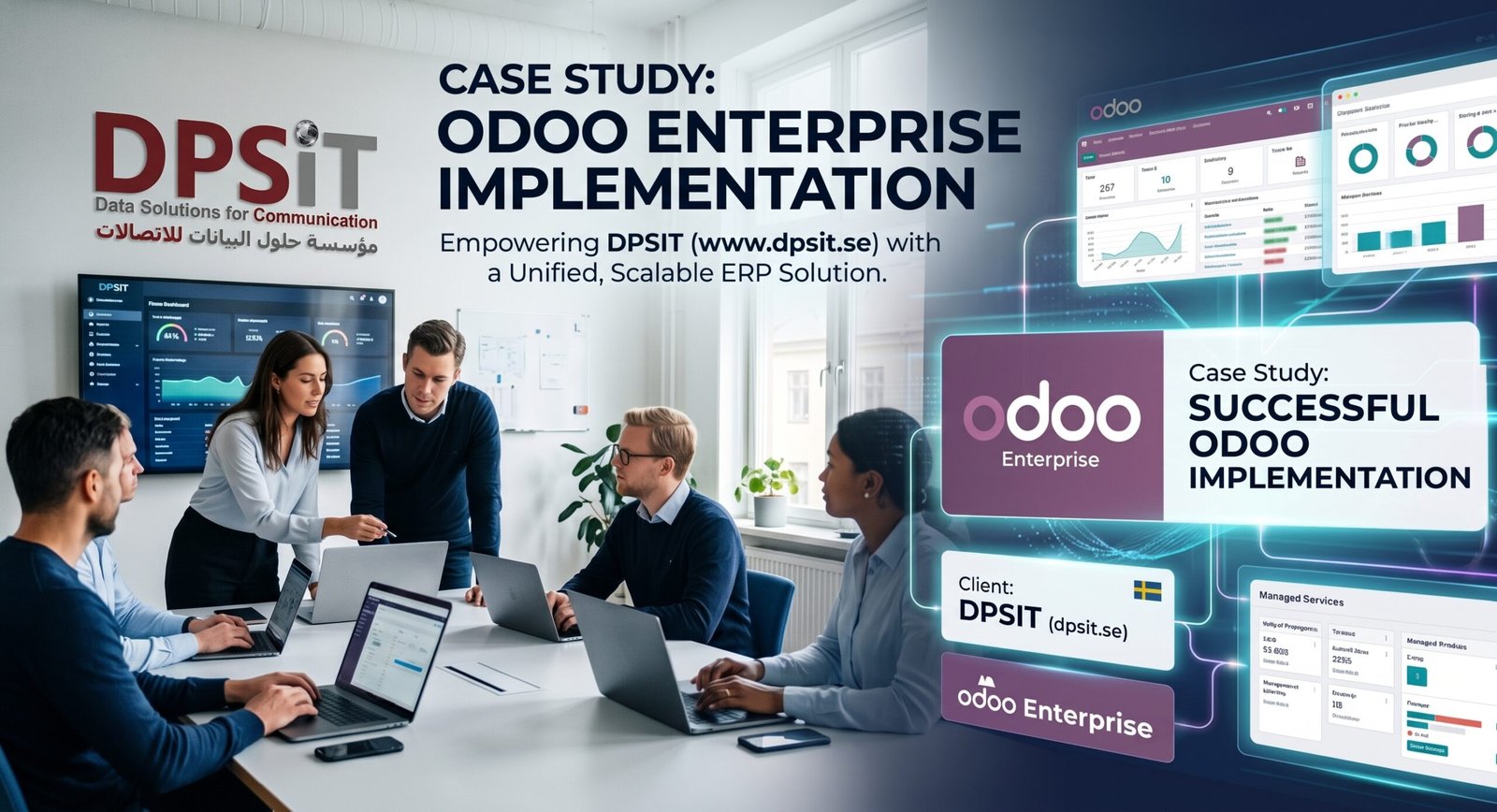
This case study shows how Odoo for IT services helped DPSIT (Data Solutions for Communication) connect sales, project delivery, timesheets and accounting in one system. DPSIT is a technology solutions provider that delivers IT services, software solutions and consulting to clients across many industries. As its customer base and project portfolio grew, the tools it used to run the business stopped keeping pace.
Working with OzonLayer, a verified Odoo Silver Partner, DPSIT moved to a single integrated platform built on Odoo CRM, Odoo Project, Timesheets and Accounting. The results were measurable: 40% faster project billing, a 30% improvement in resource utilization and a 50% reduction in manual reporting effort. Below we explain the challenges, the setup, how the work was delivered and what other service firms can learn from it.
In this case study

DPSIT at a glance
| Item | Details |
|---|---|
| Client | DPSIT (Data Solutions for Communication) |
| Industry | Information Technology & Consulting Services |
| Solution | Odoo CRM, Projects, Timesheets & Accounting |
| Implementation partner | OzonLayer IT Services |
| Modules | CRM; Project Management; Timesheets & Resource Management; Accounting & Finance; Management Dashboards |
| Services | Business process analysis, Odoo ERP implementation, CRM configuration, project management setup, Accounting ZATCA integration, user training, go-live support |
| Headline results | 40% faster project billing; 30% improvement in resource utilization; 50% reduction in manual reporting effort; 25% increase in project profitability visibility; 100% centralized customer and project management |
About the client
DPSIT is a technology solutions provider. Its work spans three related lines: IT services, software solutions and consulting services, delivered to clients in a wide range of industries. Like most firms in this space, its revenue depends on winning the right opportunities, staffing projects with the right people and billing accurately for the time and milestones delivered.
As the company expanded its customer base and project portfolio, it needed a centralized platform to manage four things together: sales opportunities, project execution, resource allocation and financial operations. To improve operational efficiency and gain clearer business visibility, DPSIT partnered with OzonLayer to implement Odoo ERP.
The choice reflects a common turning point for growing service companies. A handful of spreadsheets and standalone tools can carry a small team, but every new client and every new project adds handoffs between sales, delivery and finance. Past a certain point, the cost of those handoffs shows up in late invoices, overloaded staff and reports that are out of date before anyone reads them.
The business challenges
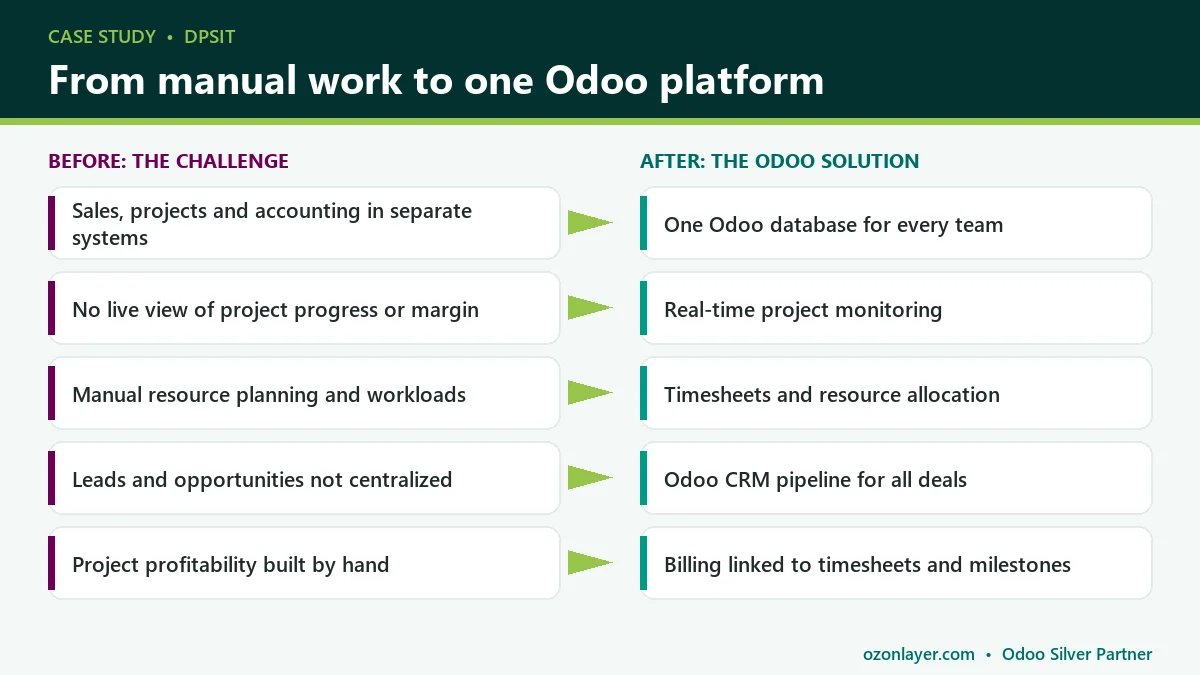
Before the project, DPSIT faced five connected problems. Each one on its own was manageable; together they limited how quickly the company could grow and how confidently management could make decisions.
Disconnected business processes
Sales, project management, timesheets and accounting were managed through separate systems. That created data silos and inefficiencies, because the same customer, project or hour of work had to be recorded more than once and reconciled by hand.
For an IT services firm, this is more than an annoyance. A deal closed in one tool has to become a project in another, then hours in a third, then an invoice in a fourth. Every transfer is a chance for something to be missed, delayed or billed at the wrong rate.
Limited project visibility
Management lacked real-time insight into project progress, resource utilization and project profitability. Questions such as “which projects are behind schedule?” or “which contracts are actually making money?” could not be answered quickly.
When profitability is only visible after a project closes, it is too late to correct scope creep, renegotiate, or move people to more valuable work. Service businesses live on margins that change week by week, so delayed visibility is expensive.
Manual resource planning
Assigning resources and tracking employee workloads was time-consuming and difficult to manage. Without a shared view of who was working on what, planners relied on memory, messages and spreadsheets.
In a people-based business, staff time is the main product. Poor allocation leads to two costly outcomes at once: some consultants are overloaded and burn out, while others sit partly idle, and both hurt delivery quality and margins.
Inefficient customer relationship management
Lead tracking, opportunity management and customer communications were not centralized, which affected sales performance. Information about a prospect could sit in one salesperson’s inbox where nobody else could see it.
IT services sales cycles often involve several conversations, proposals and technical discussions. If that history is scattered, follow-ups slip, forecasts become guesswork and handover from sales to delivery loses important context.
Delayed financial reporting
Project revenues, expenses and profitability reports required manual consolidation from multiple sources. Finance had to pull figures from different systems and stitch them together before management could review them.
Manual consolidation is slow and error-prone. It also means that the people best placed to analyze the numbers spend their time collecting them instead.
Why DPSIT chose Odoo and OzonLayer
The core issue was fragmentation, so the answer had to be one platform where sales, delivery and finance share the same records. Odoo fits that need well for service companies. Odoo CRM, Odoo Project, Timesheets and Accounting are built on a single database, so an opportunity can become a sales order, the sales order can create a project, logged hours flow to the project, and the project feeds invoicing without re-entry.
Odoo is also modular. A firm can start with the apps it needs today and add others later without changing platforms. For a growing IT services company, Odoo for IT services keeps the first phase focused while leaving room for the next one.
DPSIT chose OzonLayer as its implementation partner. OzonLayer is a verified Odoo Silver Partner based in Riyadh that implements, customizes, integrates and supports Odoo for businesses in Saudi Arabia and the UK. Our Odoo consulting services start with understanding how a business actually runs before any configuration begins, which mattered here because DPSIT’s challenges sat in the handoffs between departments rather than inside any single one.
The solution: Odoo for IT services modules implemented
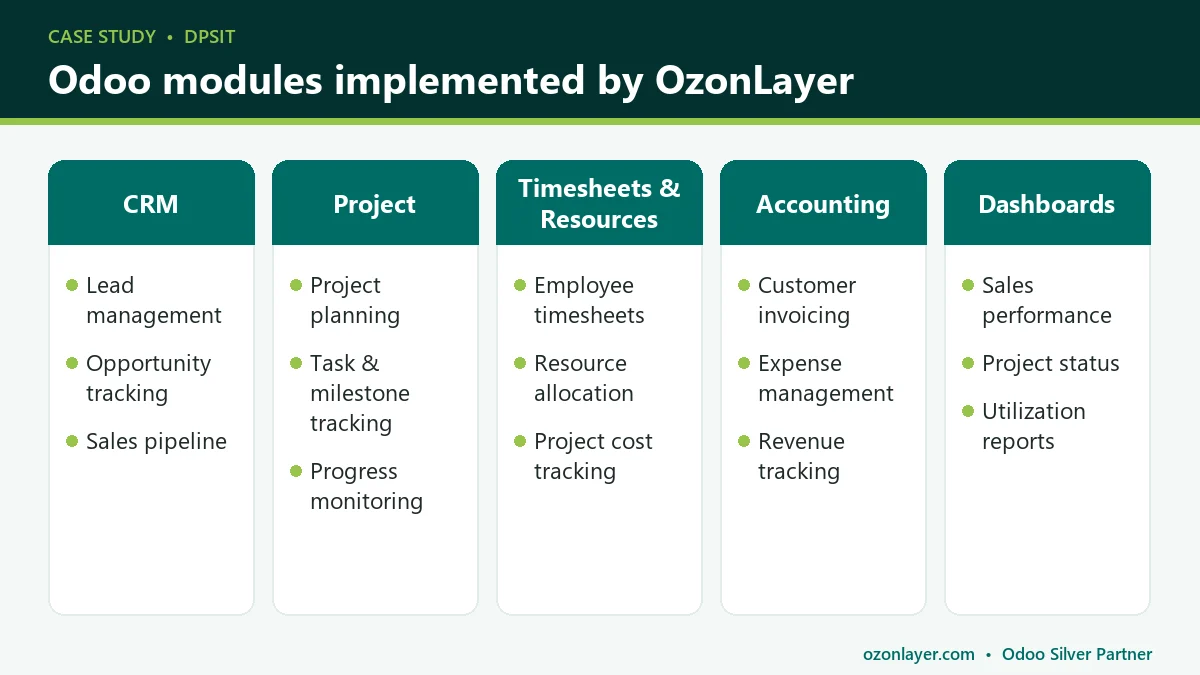
OzonLayer implemented a fully integrated Odoo ERP solution to centralize operations and improve business performance. The scope covered five areas that together form the backbone of Odoo for IT services: customer acquisition, project delivery, time and resources, finance, and management reporting.
Odoo CRM: leads, opportunities and pipeline
Odoo CRM became the single place where DPSIT tracks every prospect and customer conversation. Leads are captured and qualified, converted into opportunities, and moved through pipeline stages that reflect how the company sells. Activities, emails and notes stay on the opportunity record, so anyone picking up a deal can see its full history. The official Odoo CRM documentation explains the standard pipeline concepts this setup builds on.
- Lead management
- Opportunity tracking
- Sales pipeline management
- Customer communication tracking
Odoo Project: planning, tasks and milestones
The Odoo Project app was set up to manage delivery from kickoff to completion. Projects are broken into tasks with owners and deadlines, organized in stages that match DPSIT’s delivery process, and tied to milestones that mark key points in each engagement. In Odoo Project, managers can follow progress from a Kanban board, a list or a timeline, depending on how they prefer to work.
- Project planning
- Task management
- Milestone tracking
- Project progress monitoring
Timesheets and resource management
Timesheets connect people to Odoo Project tasks. Employees log hours against the tasks they work on, which gives managers an accurate picture of where time goes. Those same entries drive utilization monitoring and project cost tracking, because each hour carries a cost. The Odoo Timesheets documentation describes how time entries link to projects and billing.
- Employee timesheet tracking
- Resource allocation
- Utilization monitoring
- Project cost tracking
Accounting and finance
The Accounting app closes the loop from delivery to cash. Customer invoices are generated from the work recorded in projects and timesheets, expenses are captured against the right projects, and revenue is tracked as it is earned. The services delivered included Accounting ZATCA integration, so invoicing was set up with e-invoicing compliance in mind. You can read more about Odoo accounting with ZATCA e-invoicing on our service page.
- Customer invoicing
- Expense management
- Revenue tracking
- Financial reporting
Management dashboards
Because all the data now lives in one system, management dashboards could be built on top of it instead of being assembled by hand. Leadership can review sales performance, project status, resource utilization and financial results from the same set of records that the teams use every day.
- Sales performance dashboard
- Project status dashboard
- Resource utilization reports
- Financial performance analytics
Key features implemented
Beyond the individual apps, five capabilities made the biggest difference to how DPSIT runs day to day.
Centralized customer management
All customer interactions, leads, opportunities and sales activities were consolidated into a single Odoo CRM platform. Sales, delivery and finance now refer to the same customer record in Odoo CRM, which removes duplicate data and makes handovers cleaner.
Real-time project monitoring
Using Odoo Project, project managers gained visibility into project progress, deadlines, task completion and resource utilization. Instead of waiting for status meetings, they can see which tasks are overdue and which projects need attention while there is still time to act.
Resource planning and allocation
Management can now assign resources efficiently based on availability, skills and project requirements. A shared view of workloads makes it easier to balance demand across the team and to plan staffing for upcoming work.
Automated project billing
Timesheets and project milestones were linked directly to customer invoicing. This reduced manual effort and billing delays. In practice, it means billable hours and completed milestones are ready to invoice without someone re-keying them from another system, a pattern that suits both time-and-materials and milestone-based contracts.
Executive reporting
Customized dashboards gave management real-time business intelligence across sales, projects and finance. Decisions about pricing, hiring and which work to pursue can be based on current data rather than last month’s spreadsheet.
Implementation approach
OzonLayer delivered this Odoo for IT services project through a structured set of services. Each step built on the previous one, so that the final system reflected how DPSIT actually sells, delivers and bills. This is the same approach behind our Odoo implementation services for other clients.
- Business process analysis. We started by mapping how work moved from first contact to final invoice, and where information was being lost or duplicated between sales, delivery and finance.
- Odoo ERP implementation. We configured the core platform and connected the apps so records flow from one stage to the next without re-entry.
- CRM configuration. In Odoo CRM, we set up lead capture, pipeline stages, activities and communication tracking to match DPSIT’s sales process.
- Project management setup. In Odoo Project, we configured projects, task stages, milestones and timesheets so delivery teams could plan and log work in one place, with that work available for billing.
- Accounting ZATCA integration. We set up accounting and invoicing with ZATCA e-invoicing integration, so the billing output of the new process meets compliance requirements.
- User training. We trained users on the parts of the system they rely on, from salespeople updating opportunities to consultants logging time and finance staff issuing invoices.
- Go-live support. We supported the team as they moved onto the new system, resolving questions and adjusting configuration as real work started to flow through it.
If you are weighing up partners for a similar Odoo for IT services project, our guide on how to compare Odoo implementation proposals explains what to look for in scope, method and support.
Results achieved
With sales, projects, time and finance running on one platform, DPSIT saw improvements across every area that had been a problem before.
Improved project visibility
Through Odoo Project, project managers gained real-time access to project status. That enabled proactive decision-making and better project control, because issues surface while they can still be fixed.
Increased resource utilization
Optimized resource allocation improved team productivity and reduced workload imbalances. People are assigned where they are needed, and managers can see when someone is stretched too thin.
Enhanced sales management
The centralized Odoo CRM improved lead tracking, sales forecasting and customer engagement. With the full pipeline in one place, forecasts are based on actual opportunity data.
Faster billing process
Automated invoicing reduced billing cycles and improved cash flow management. Work recorded in timesheets and milestones moves to invoices without delay.
Better financial control
Management obtained accurate insight into project profitability, revenues and operational costs, rather than waiting for manual consolidation.
Streamlined operations
Integrated business processes reduced administrative work and improved collaboration between departments, since everyone works from the same records.
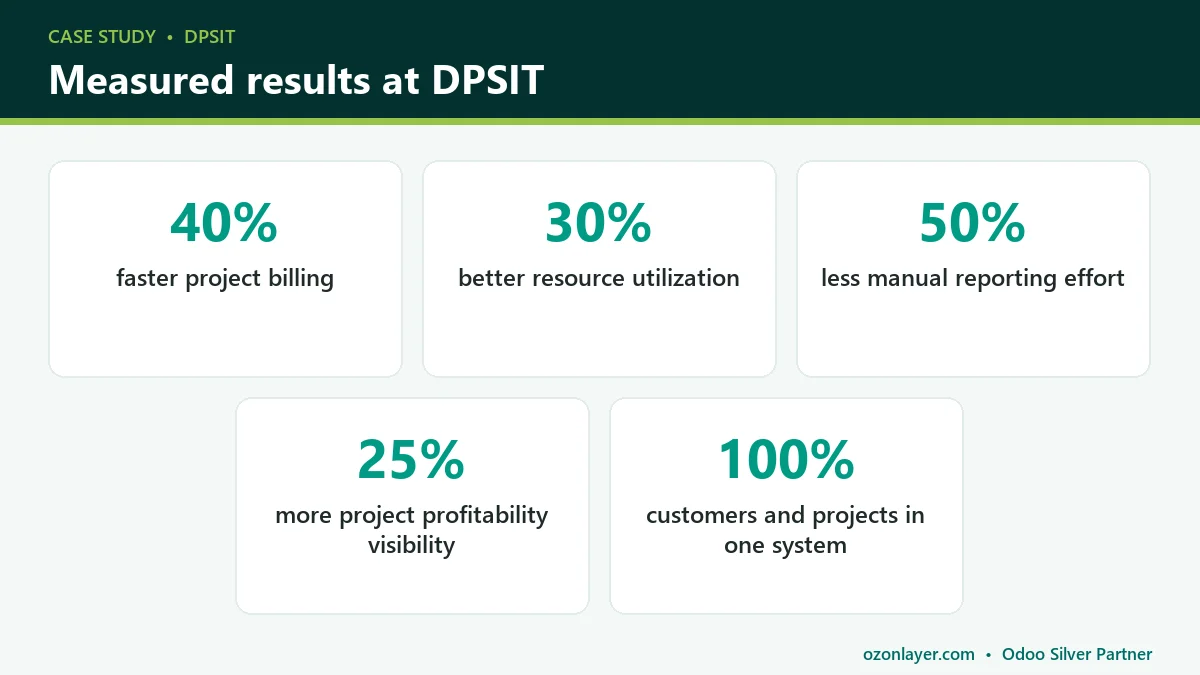
The main KPI impact reported for the implementation:
| Metric | Result |
|---|---|
| Project billing | 40% faster project billing |
| Resource utilization | 30% improvement in resource utilization |
| Manual reporting effort | 50% reduction in manual reporting effort |
| Project profitability visibility | 25% increase in project profitability visibility |
| Customer and project management | 100% centralized customer and project management |
Business impact
Taken together, the results changed how DPSIT operates across the whole service lifecycle:
- Centralized management of customers, projects and finances
- Improved project delivery and deadline tracking
- Enhanced resource utilization and workforce planning
- Faster invoicing and revenue recognition
- Real-time management reporting and analytics
- Improved customer relationship management
- Increased operational efficiency and business visibility
For a services company, these gains reinforce each other. Better Odoo CRM data leads to better Odoo Project planning, better planning leads to more accurate timesheets, and accurate timesheets lead to faster, more complete invoicing.
Lessons for IT services businesses considering Odoo
DPSIT’s experience offers practical takeaways for any IT services, software or consulting firm evaluating Odoo for IT services.
- Fix the handoffs, not just the departments. Most of the cost in a fragmented setup sits between sales, delivery and finance. Choose a platform where an opportunity, a project, a timesheet and an invoice share the same data.
- Decide your billing models early. Fixed-price, milestone and time-and-materials contracts are configured differently in Odoo. Agreeing on them during process analysis keeps invoicing simple later.
- Make timesheets easy and expected. Utilization reports and project costs are only as good as the hours logged. Train consultants on why timesheets matter and make logging part of the weekly routine.
- Design dashboards around decisions. Ask what leadership needs to decide each week, then build reports that answer those questions directly instead of showing every available metric.
- Plan for compliance from the start. If your invoices must meet e-invoicing rules such as ZATCA in Saudi Arabia, include that in the scope rather than adding it after go-live.
- Invest in training and go-live support. Adoption decides whether the system delivers. Users who understand how their records feed the rest of the business keep the data clean.
For a closer look at how these apps fit a service firm, see our pages on Odoo CRM software and Odoo project management software, or read the official Odoo Project documentation.
Frequently asked questions
Is Odoo for IT services a good fit for small and mid-sized firms?
Yes, for many of them. Odoo is modular, so a firm can begin with Odoo CRM, Odoo Project, Timesheets and Accounting and add other apps as it grows. Because these apps share one database, even a small team gets connected sales, delivery and billing without building integrations between separate tools.
How does Odoo Project connect to invoicing?
In Odoo, a sales order for a service can create a project or tasks automatically. Hours logged on timesheets, or milestones marked as reached, can then be invoiced from that sales order. This removes the need to re-enter billable work in the accounting system and reduces delays between delivery and invoicing.
Can Odoo CRM handle long B2B sales cycles?
Odoo CRM supports custom pipeline stages, scheduled activities, email tracking and notes on each opportunity. That makes it suitable for B2B sales where deals involve several meetings, proposals and decision-makers. Expected revenue and probability on each opportunity also support pipeline forecasting.
How does Odoo measure resource utilization?
Utilization is typically measured by comparing the hours employees log on timesheets, often split between billable and non-billable work, against their available working time. Odoo’s timesheet reporting lets managers see this by employee, project or period, which helps spot both overloaded staff and spare capacity.
Does Odoo support ZATCA e-invoicing in Saudi Arabia?
Odoo Accounting can be configured for ZATCA e-invoicing requirements in Saudi Arabia, and this was part of the services OzonLayer delivered for DPSIT. For another example, read our Industrial Steel Solutions ZATCA case study.
Conclusion
Through the implementation of Odoo ERP, DPSIT transformed its business operations by integrating sales, project management, resource planning and finance into a single platform. The solution provided complete visibility into project performance, improved operational efficiency and enabled management to make informed decisions based on real-time business data.
The implementation positioned DPSIT for sustainable growth while enhancing service delivery and customer satisfaction. Its experience shows what Odoo for IT services can deliver when Odoo CRM, Odoo Project, Timesheets and Accounting work as one system, with 40% faster project billing and 100% centralized customer and project management.
If your IT services or consulting firm is dealing with disconnected tools, slow billing or limited project visibility, book a free Odoo consultation with OzonLayer. We will review your processes and recommend the right Odoo setup for your team.