
Official Odoo Silver Partner
Odoo Integration Services in the UAE
Odoo integration connects Odoo ERP with the other systems your company uses, so orders, payments, stock, invoices and customer data move between them automatically. For UAE businesses the most important new connection is to the Accredited Service Provider that will exchange your e-invoices.
OzonLayer designs, builds, tests and supports integrations for UAE companies, using Odoo’s standard connectors first and the External JSON-2 API or webhooks where no connector exists. We are an official Odoo Silver Partner.
AED
UAE chart of accounts and VAT
AR / EN
Arabic and English documents
Silver
Official Odoo partner
Scope
What we connect
- E-invoicing service providers
- Online stores and marketplaces
- Payment providers and banks
- Shipping carriers
- CRM, marketing and analytics tools
- Older ERP and in-house systems
On Odoo Online, the external API needs Odoo’s Custom pricing plan.
What we connect
What Do Odoo Integration Services in the UAE Include?
Integration removes double entry between Odoo and the systems around it, one data flow at a time.
Channels
Online stores and marketplaces
Orders, customers, products, prices and stock kept in step between Odoo and the sales channels you use in the UAE, from your own website to marketplaces.
Payments
Payments and banking
Payment providers Odoo supports, bank statement synchronization and payment files, plus custom connections where no standard one exists.
Shipping
Shipping and logistics
Carrier rates, shipping labels and tracking numbers on delivery orders, and connections to warehouse or fulfilment partners.
E-invoicing
E-invoicing providers
Invoice data sent from Odoo to the Accredited Service Provider you appoint for UAE e-invoicing, with statuses and errors brought back into Odoo where the provider supports it.
Customers
CRM, marketing and analytics
Leads, customers and sales data shared with CRM, marketing and reporting tools, so every team works from the same records.
Legacy
Older ERP and in-house systems
Two-way connections with systems that stay in use alongside Odoo, built on the External JSON-2 API. See Odoo development services.
How we work
How Does an Odoo Integration Project Work?
Every integration follows six steps, so nothing touches your live data until it has been tested end to end.
For UAE businesses, workshops, reviews and training run online, and the plan is agreed in writing before work starts.
Odoo development services →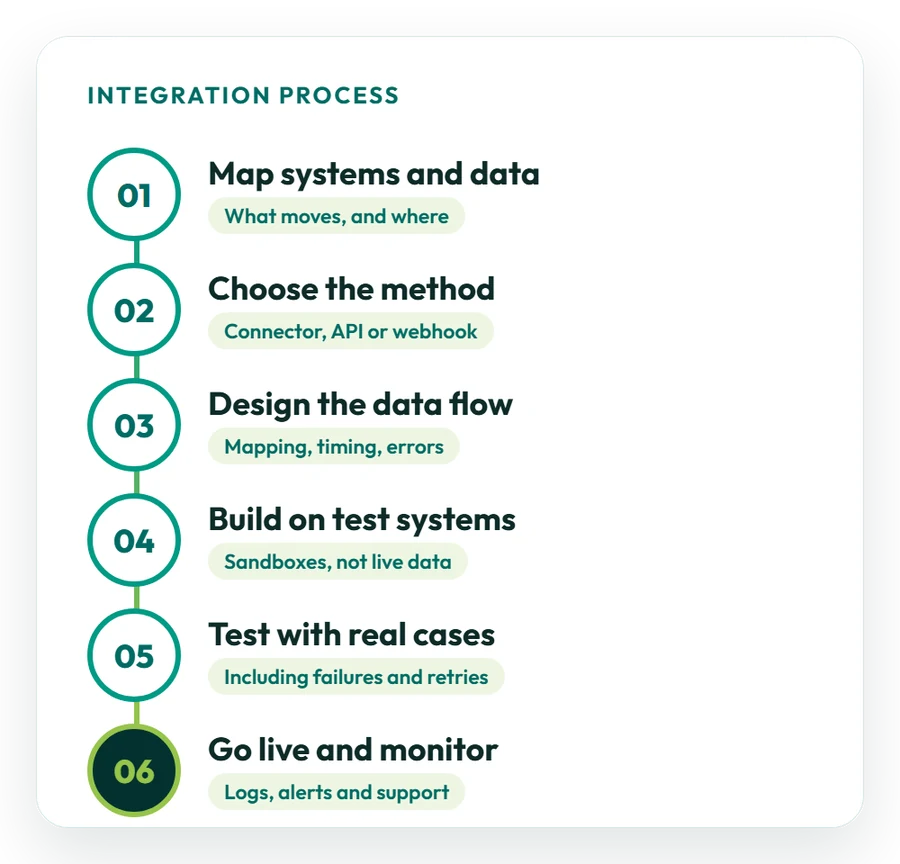
01
Map systems and data
We list every system involved and the data that moves between them: orders, products, stock, payments, invoices or customers.
02
Choose the method
Each data flow is matched to a standard connector, the External JSON-2 API, webhooks or a file exchange, and you receive a written estimate.
03
Design the data flow
We agree which system owns each record, how fields map, how often data moves and what happens when something fails.
04
Build on test systems
The integration is built against test databases and sandbox accounts, never against live data first.
05
Test with real cases
Your team tests real scenarios, including failed payments, cancelled orders, duplicates and retries, before sign-off.
06
Go live and monitor
We switch the integration on, watch the first live transactions and support it afterwards through Odoo support.
Choosing the method
Which Odoo Integration Method Fits Your Systems?
Use a standard connector where one exists; build on the API or webhooks only where it does not.
We recommend a method for each data flow and explain the trade-offs in cost, speed and upkeep.
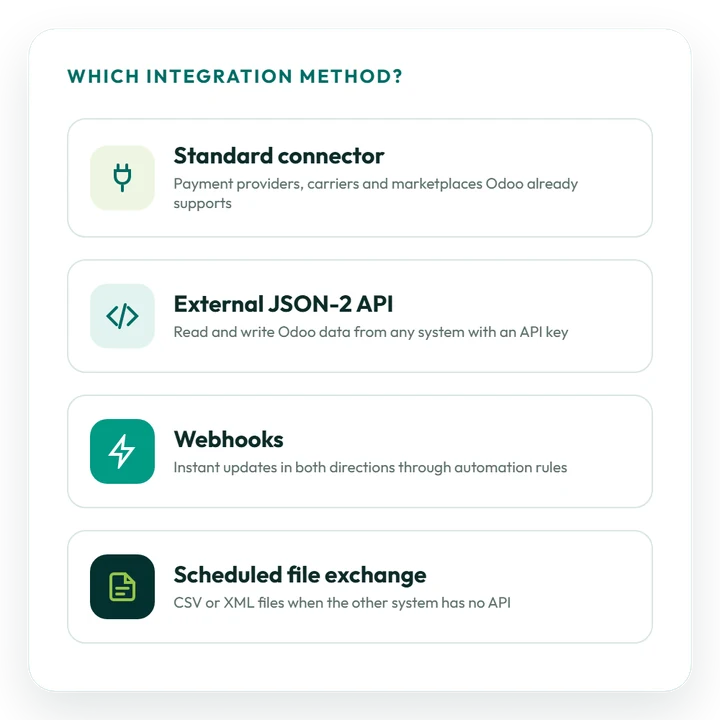
Standard connector
Payment providers, shipping carriers, bank synchronization and other connections that Odoo already supports, configured rather than built.
External JSON-2 API
Another system reads and writes Odoo data over HTTP with an API key. It replaces the older XML-RPC and JSON-RPC API.
Incoming webhooks
An automation rule gives Odoo a webhook URL, so another system can trigger an update the moment something happens.
Outgoing webhooks
An automation rule sends data to another system’s webhook when a record is created or changed in Odoo.
Scheduled file exchange
CSV or XML files exchanged on a schedule, for systems that have no API.
Integration platform
When many applications are connected, an integration platform can sit in the middle; it still talks to Odoo through the API.
UAE e-invoicing
How Will Odoo Connect to UAE E-Invoicing?
Each business appoints an Accredited Service Provider, and the provider exchanges invoices on the Peppol network. Odoo needs to send complete invoice data to that provider and receive its responses. The timetable:
- 1 July 2026: pilot with selected businesses, and voluntary adoption opens;
- 1 January 2027: mandatory for businesses with revenue of AED 50 million or more;
- 1 July 2027: mandatory for businesses with revenue below AED 50 million;
- 1 October 2027: mandatory for government entities;
- How it works: invoices are exchanged in the PINT AE format over the Peppol network through an Accredited Service Provider that each business appoints, and invoice data is reported to the Federal Tax Authority.
Dates from Ministerial Decisions No. 243 and No. 244 of 2025; see the Ministry of Finance e-invoicing programme and EY’s summary. Check the Ministry of Finance for any later changes before you plan.
Talk to an integration expert →UAE localisation
Which UAE Data Do Your Integrations Need to Carry?
Integrations should move data that is already correct for UAE tax and payroll. These are the localisation features your connections rely on:
VAT
VAT and the VAT201 return
Odoo’s UAE localisation sets up 5% standard-rated, zero-rated, exempt and reverse-charge VAT, and builds the VAT201 return in the FTA’s format for filing on EmaraTax. See the Odoo UAE documentation.
Corporate Tax
Corporate Tax reporting
Odoo’s corporate tax report shows net profit, exempt income, allowable deductions and disallowed expenses. Odoo ships no default tax categories, so accounts are tagged during set-up with your accountant.
Payroll
UAE payroll and WPS
The UAE payroll localisation covers housing and transport allowances, annual leave, end-of-service provisions, WPS salary reports and the Emiratisation report. See the UAE payroll documentation.
Arabic
AED, Arabic and English
AED as the company currency with automatic exchange rates, users working in Arabic or English, and customer documents in either language, or in a bilingual layout where you need one.
Before you start
How Should You Prepare for an Odoo Integration?
Good preparation gives you a more accurate estimate and a faster start.
Not sure which systems to connect first? Our consultants can review your processes and recommend priorities.
Odoo consulting services →01
List the systems
Name every application involved, its owner on your side and the data you want to move.
02
Share API access
Collect the other system’s API documentation and a test (sandbox) account we can build against.
03
Decide who owns the data
Agree which system is the master for products, prices, stock, customers and orders.
04
Describe volumes and timing
Estimate daily orders or transactions, and decide what must move instantly and what can move on a schedule.
05
Confirm plan and hosting
Tell us your Odoo version, edition and hosting; on Odoo Online, the external API needs the Custom plan.
Timeline and cost
How Much Does Odoo Integration Cost in the UAE?
It depends on scope. Setting up a standard connector is usually a short piece of work; a custom two-way integration takes longer and is often delivered one data flow at a time.
What affects cost and timeline
- the number of systems and types of data;
- one-way or two-way synchronization;
- the quality of the other system’s API and documentation;
- transaction volumes and real-time needs;
- error handling, logging and monitoring;
- your Odoo plan, version and hosting.
The External JSON-2 API is available on Odoo plans that include it, and some connectors carry their own fees. You receive a scoped proposal for each integration.
Request a proposal →Typical integration sizes
These examples are indicative; your estimate confirms scope after the mapping step:
- Connector setup: a payment provider, shipping carrier or bank connection that Odoo already supports;
- One-way integration: data sent from one system to the other, such as orders into Odoo;
- Two-way integration: several data types kept in step in both directions, delivered one flow at a time.
You receive a written estimate before any work starts.
Case studies
Odoo Integration Projects We Have Delivered
Our published case studies come from projects in Saudi Arabia. The processes behind them, multi-branch retail, e-invoicing, restaurants and project billing, are the same ones UAE businesses run in Odoo. See all case studies.
Retail
Salla and Salesforce
How Match Perfumes connected Odoo with Salla and Salesforce through direct REST APIs and real-time webhooks. Read the case study
E-invoicing
ZATCA Phase 2
How Industrial Steel Solutions connected Odoo Accounting to ZATCA for automated e-invoice clearance and reporting. Read the case study
IT services
Projects to invoices
How DPSIT connected sales, projects, timesheets and accounting, and made project billing 40% faster. Read the case study
Restaurants
POS to accounting
How Sweet & Salty connected point of sale, ingredients, purchasing and accounting in one system. Read the case study
Why OzonLayer
Why Choose OzonLayer for Odoo Integration in the UAE?
Facts you can check before you speak to us.
01
Official Odoo Silver Partner
OzonLayer IT Services is listed as a Silver Partner in the Odoo partner directory, with customer references published on our partner page.
02
Consultants and developers together
Functional consultants map the business process, and in-house developers build the integration on the API or webhooks.
03
Support after go-live
The team that builds your integration also monitors it, fixes issues and updates it when either system changes.
04
Delivered remotely for the UAE
Projects for UAE businesses are run online by our teams in Riyadh, London and Pakistan, with working hours that overlap the UAE business day.
Working in another market? See Odoo integration in the UK, Saudi Arabia or our Odoo integration services page.
FAQs
Odoo Integration in the UAE: Frequently Asked Questions
Can’t find what you need? Our team replies to every enquiry with a straight answer on scope, timeline and budget.
Ask an integration expert
What are Odoo integration services in the UAE?
They connect Odoo with the other systems a UAE business uses, such as online stores, marketplaces, payment providers, banks, carriers, CRM tools and e-invoicing providers, so data moves automatically and is not entered twice.
How will Odoo connect to UAE e-invoicing?
Each business appoints an Accredited Service Provider that exchanges invoices in the PINT AE format over the Peppol network and reports them to the Federal Tax Authority. We connect Odoo to the provider you choose and test the flow before your mandatory date.
When does UAE e-invoicing become mandatory?
Under Ministerial Decision No. 244 of 2025, from 1 January 2027 for businesses with revenue of AED 50 million or more, from 1 July 2027 for other businesses, and from 1 October 2027 for government entities. A pilot started on 1 July 2026.
Which systems can Odoo integrate with?
Online stores and marketplaces, payment providers, banks, shipping carriers, CRM and marketing tools, e-invoicing providers, older ERP systems and in-house applications. Standard connectors are used where they exist.
What is the Odoo External JSON-2 API?
It is Odoo’s current external API, introduced in Odoo 19. Other systems call Odoo models over HTTP with an API key. It replaces the older XML-RPC and JSON-RPC API, which is deprecated.
Do integrations built on XML-RPC or JSON-RPC need to be replaced?
They should be planned for replacement. The older API is deprecated, so we move existing connectors to the JSON-2 API as part of an upgrade or a support plan.
Can Odoo Online be integrated with other systems?
Yes, through standard connectors and the external API on plans that include it. Custom middleware or modules may need Odoo.sh or your own servers.
How much does Odoo integration cost?
It depends on the number of systems and data types, one-way or two-way sync, the quality of the other API, volumes, and monitoring. Standard connectors are quick; custom two-way integrations are delivered in phases.
How do you keep Odoo integrations secure?
We use API keys with limited access, encrypted connections, separate integration users and logs of every exchange, and we test with a copy of your data before go-live.
What happens when an integration fails?
Failed messages are logged with the reason, retried where safe and flagged to your team, so nothing is lost silently. Under a support plan we monitor and repair failures.
Do you work with UAE businesses remotely?
Yes. Integration design, build and testing run online with our team in Riyadh, London and Pakistan, during hours that overlap the UAE business day.
Official Odoo Silver Partner
Connect Odoo with the systems you use in the UAE
Tell us which systems you want to connect, the data that should move and how often. We will review the APIs involved and send a scoped proposal.
Call UK +44 7477 204638 · KSA +966 56 434 5818 · Email info@ozonlayer.com